Announcing AI-Native Market Access Product for Regulated Products

Learn More

Blogs

RIM

RIM 101: what is regulatory information management?

By

Michael Peach

November 1, 2021

4 min read

Regulatory Information Management (RIM) refers to a category of software solutions that are designed to support and streamline the activities of regulatory affairs (RA) teams. For most teams they are a net-new category of software, and generally replace manual processes that are paper-based or run using traditional productivity software (spreadsheets and docs). RIM systems first emerged to support pharmaceutical regulatory activities, but in recent years medtech-focused solutions have hit the market as well.

Given their general new-ness, especially for medtech RA teams, it’s not surprising that many teams are unfamiliar with the technology. In our, admittedly informal, survey of RAPS 2021 attendees, only 11% of respondents said they currently use a RIM system, and 33% had no knowledge of the category at all. This article provides some background on what RIM systems are, and what they do to help medtech RA teams operate more effectively.

Want to learn more? Watch our interactive video series

The role of regulatory affairs in medtech

To understand RIM systems, first we have to look at the role of regulatory affairs. In medtech, which includes medical devices, in vitro diagnostics, and medical software, RA teams play a critical role across a product’s lifecycle.
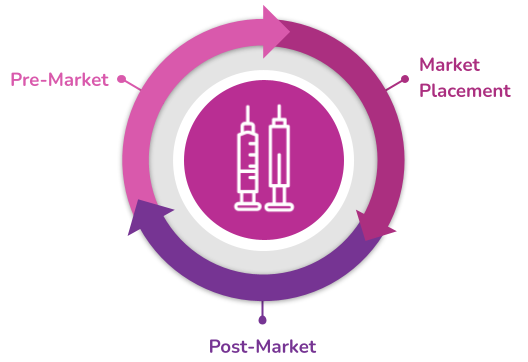

Before products are released for sale, RA teams work closely with research and development (R&D) teams to ensure that a new product meets necessary local requirements to be legally marketed in the desired target markets. There are over 113 different regulatory regimes around the world that medical devices are subject to. While there are many similarities, RA teams must understand the nuances between countries and guide R&D to ensure that products are developed accordingly.

Once products obtain market clearance, RA teams switch to monitoring mode to ensure that products can remain on the market. This includes keeping track of expiration dates and certificates, any changes in regulations or international standards that could impact the product, and any changes in the product or it’s technical documentation. Health authorities in many countries regularly perform product audits, so keeping all information in order and up-to-date is an important part of regulatory work.

RA teams usually take the lead on post-market surveillance activities as well, working closely with their quality assurance (QA) counterparts. They track adverse events and complaints, compiling this information from public and internal sources, and ensure that the data is reported appropriately to health authorities. Not all markets require extensive post-market surveillance for medical devices, but these regulations are becoming more common. Both the EU and Canada have recently implemented expanded surveillance requirements including the need for regular summary reporting to continuously confirm product performance and safety.

The information challenge

All of the regulatory activities highlighted in the previous section are repeated for every individual product the company sells in every regulated country or region. And, all of these activities are highly dependent on specific information. To do their jobs effectively, medtech regulatory affairs professionals need insight into global regulations and standards, detailed product specifications, testing, performance, and safety data, and a full record of all regulatory registrations and processes.

The problem is that this information is often scattered across the company. It’s stored in multiple systems, (sometimes physical) documents, and individual employees’ heads. Because this information is so scattered, RA professionals can spend up to 50% of their time just looking for things, and simple requests such as identifying whether a product has clearance to be marketed in a specific country can take days to complete.

How RIM systems can help

At a fundamental level, RIM systems are about helping RA teams corral and manage all of the information they need to do their jobs. RIM systems serve as a “single source of truth” for RA teams. They store and manage regulatory documents, integrate with systems across the company, and create a traceable record of all regulatory activities. All of this information is linked to individual products and countries or regions, making it much easier to find.

All of the collected information in a RIM system can be used to streamline regulatory activities across the product lifecycle. Before products are released, they provide access to regulatory intelligence, including market entrance requirements, that RA teams can use to guide product development and regulatory submissions. RIM systems also provide a collaborative digital hub where teams can author and assemble supporting documentation for new regulatory submissions.

For products currently on the market RIM systems can monitor registration expiration dates, and track changes in relevant standards and regulations to identify potential product impacts. This automated monitoring can give RA teams an “early warning”, and allow them to accommodate changes that might impact the selling status of a product.

RIM systems can also help with post-market surveillance activities. They can collect and centralize post-market data analytics, and facilitate planning and active surveillance activities to meet the most current regulatory requirements. These systems can also ensure that actions and conclusions drawn from the post-market surveillance process are consistently applied throughout the quality management system. And, the same authoring capabilities used to assemble pre-market submissions can be used for post-market reporting and communication with regional regulatory authorities.
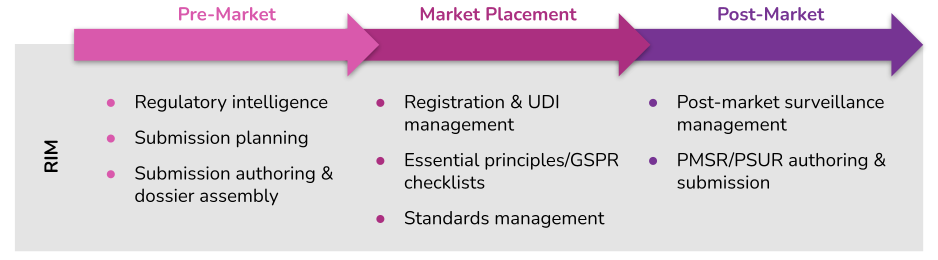
RIM capabilities across the regulatory lifecycle

Project planning, tracking, and management

Underpinning all of these capabilities is a full set of project features that allow RA teams to effectively manage and track their activities. This can include project request features that allow internal teams or 3rd-party partners such as local distributors to request specific regulatory activities or information. RIM systems also provide project task management, approval workflows, and digital signature capabilities that are fully auditable, and 21 CFR Part 11 compliant.

RIM systems also provide detailed reporting in the form of customized dashboards and registration, product, standards, and documentation reports. These reports offer at a glance monitoring of key information and detailed visibility into regulatory status and activities. For many teams this level of visibility is new, and allows them to fully measure, benchmark and report on their activities to company leadership.

The impact of RIM systems

RIM systems can have a tremendous impact on RA teams. By centralizing information they improve team productivity by ensuring that up-to-date information is always easily available and consistently applied. By automating workflows like new submission creation, or essential principles/GSPR table assembly they ensure that work gets done quickly and in-line with country/region requirements. RIM systems also provide more visibility into regulatory activities, allowing teams to benchmark and more accurately forecast the time required for new market clearance, and other product milestones.

To the company, the increased regulatory efficiency and effectiveness means reduced revenue risk from noncompliance or having to pull products from market, stronger, more confident global regulatory compliance, and ability to get new products to market much more quickly.

To learn more about RIM systems, their key capabilities, and if your organization could benefit from bringing one onboard, read our RIM System Buyer’s Guide for Medtech Companies.

Similar posts

AI

Regulatory operations

MedTech

Why Enterprise AI in MedTech Regulatory Is 90% Foundation: The Iceberg Problem

By

James Gianoutsos

November 11, 2026

4 min read

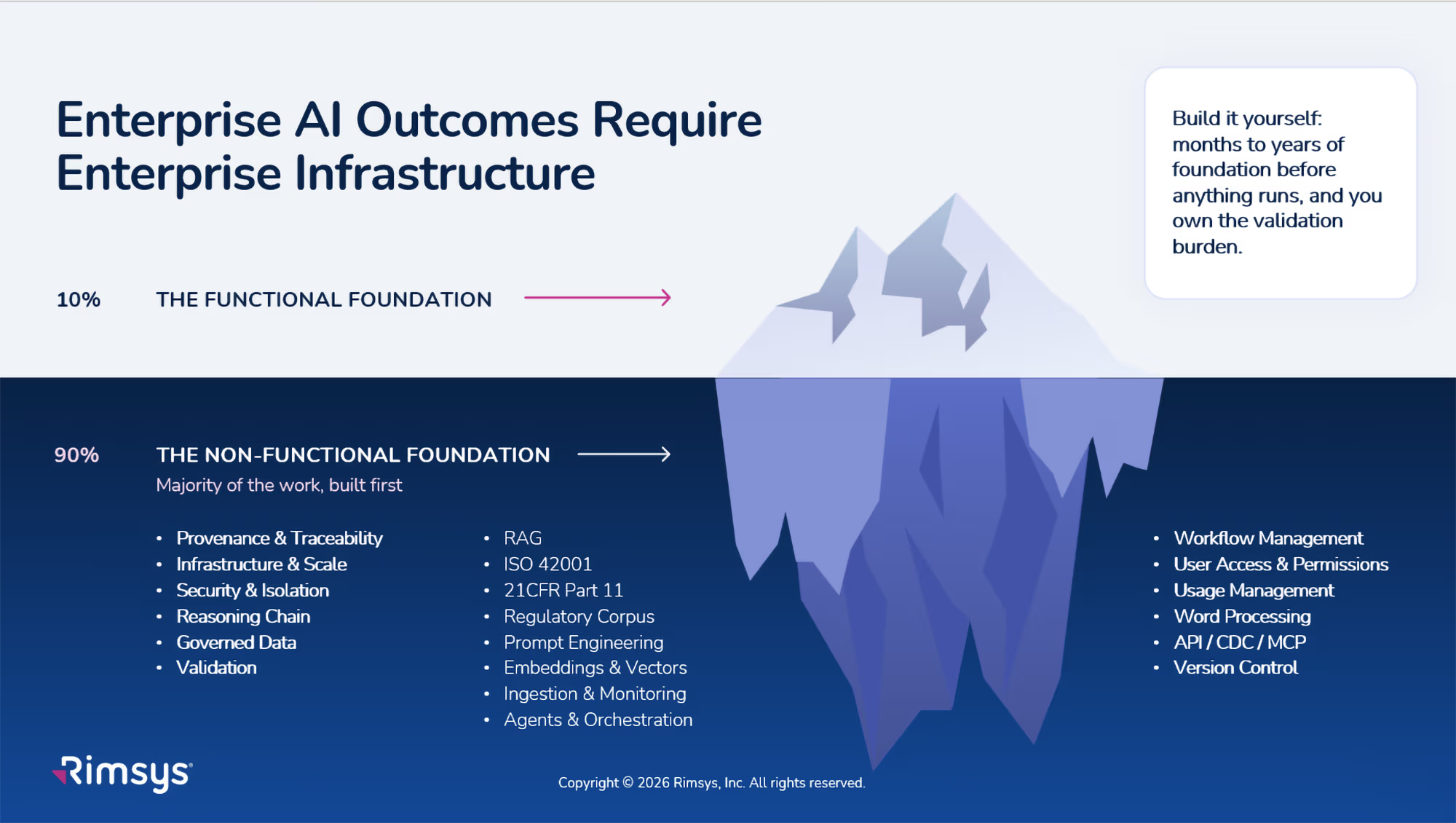
The AI demo is the easy part. In MedTech regulatory operations, the features a team sees in a demo represent roughly 10% of the work required to run enterprise AI. The other 90% sits below the waterline.

Most regulatory leaders have now seen an impressive AI demo. A model drafts a submission summary, answers a question about market requirements, or flags a gap in a technical file. It looks finished. It is not.

What makes AI usable in a regulated environment is everything the demo never shows: the governance, data, and operational foundation that lets a regulatory team trust an output, trace it, and defend it in an audit. That foundation has to be built first, and it is where the real effort lives.

The 10% you can see

The functional layer is what users interact with: the context window, a generated draft, an answer or summary, and maybe a recommendation. It is what vendors showcase and what internal pilots usually build first.

This layer matters. But on its own, it answers only one question: can the model produce something useful? In regulatory work, the harder questions follow immediately. Where did that answer come from? Who approved it? Can we prove it was correct on the day we relied on it? How do we prove it to an auditor? Whatever the answer is, we can all agree it can't be "we stumbled across this Reddit thread."

The functional layer cannot answer any of those hard questions. The foundation underneath it has to, and it has to be trusted and defensible.

Below the waterline: trust and governance

So what does a trusted, defensible foundation look like? It is built from the controls that let a regulatory team stand behind every AI output, because "the model said so" will not hold up with an auditor or a quality system.

  • Provenance and traceability. Every output links back to the source data and documents it drew from.
  • Reasoning chain. Reviewers can see how the system reached a conclusion, not just the conclusion itself.
  • Governed data. The AI works only from controlled, current, approved information.
  • Validation. The system is validated for its intended use, and revalidated as models and data change.
  • Security and isolation. Sensitive product and submission data stays protected and separated.
  • Compliance frameworks. 21 CFR Part 11 for electronic records and signatures, ISO 27001 certification, SOC 2 Type II, ISO/IEC 42001 certification nearing completion, penetration testing, independent audits, and more.

None of these are features a user clicks. All of them determine whether a regulatory team can actually rely on what the AI produces.

Below the waterline: data and intelligence

A general-purpose model does not know your products, your registrations, or the nuances of more than 130 markets. Making it useful for MedTech regulatory work takes a dedicated intelligence layer.

  • Regulatory corpus. A curated, maintained body of regulations, guidance, and requirements by market.
  • Retrieval-augmented generation (RAG). Answers grounded in your own structured data and approved sources, not the model's general training.
  • Embeddings and vectors. The indexing that lets the system find the right record or clause quickly and accurately.
  • Prompt engineering. Tested, controlled instructions tuned to regulatory tasks.
  • Ingestion and monitoring. Pipelines that keep data current and watch for drift or degraded output quality.
  • Agents and orchestration. Coordination of multi-step tasks, with clear checkpoints for human review.

This is where domain specificity is won or lost. Generic AI layered on top of documents produces generic answers. AI built on a structured regulatory data model produces answers that reflect real requirements, country nuances, and product context.

Below the waterline: operations at enterprise scale

Even trustworthy, well-grounded AI fails if it cannot live inside the way regulatory teams actually work. The operational layer turns a capability into a system.

  • Workflow management. AI output flows into review, approval, and change control, not a separate chat window.
  • User access and permissions. The right people see the right data, across regions, partners, and in-country sponsors.
  • Usage management. Visibility into how AI is used, by whom, and at what cost.
  • Version control. A complete history of what changed, when, and why.
  • Word processing. Drafts land where regulatory content is authored and finalized.
  • APIs, change data capture, and MCP. Connections to ERP, PLM, QMS, and the rest of the enterprise stack.
  • Infrastructure and scale. Performance that holds up across the most complex global portfolios.

This is the layer that separates a promising pilot from an operation a global regulatory team can run every day.

The build-it-yourself reality

For organizations considering an in-house build, the iceberg changes the math. The foundation comes first, and it can take months to years before anything useful runs.

The ownership does not end at launch, either. A team that builds its own regulatory AI also owns its validation, its audit defense, and its upkeep as models, regulations, and data evolve. That work lands on the same people who were supposed to be freed up by AI in the first place.

Building is not wrong for every organization. But it should be a deliberate decision made with the full iceberg in view, not just the 10% above the surface.

Five questions to ask before you build or buy

Whether the AI comes from an internal team or a partner, these questions surface what sits below the waterline:

  1. Can every AI output be traced to its source data, with the reasoning visible to a reviewer?
  2. Who validates the system, and what happens to that validation when the model or data changes?
  3. Is the AI grounded in a structured regulatory data model, or layered on top of documents?
  4. Does AI output move into governed workflows, with human review and approval built in?
  5. Is AI something your team can turn on when ready, or is it a prerequisite for using the platform?

If the answers are vague, the foundation probably is too.

Enterprise AI outcomes require enterprise infrastructure

The organizations getting real value from AI in regulatory operations are not the ones with the most impressive demos. They are the ones that invested in the foundation first: governed data, traceable outputs, validated systems, and workflows that keep human judgment firmly in control.

At Rimsys, that foundation is the platform. Rimsys AI runs on the same structured regulatory data model, governed workflows, and enterprise infrastructure that 6 of the top 12 global MedTech manufacturers rely on today. And because not every team is ready for AI at the same time, it is a configuration option: available when you are ready to accelerate, optional when you are not.

Want to see what sits below the waterline? Talk to our team about how Rimsys brings trusted AI to the heart of regulatory operations.

AI

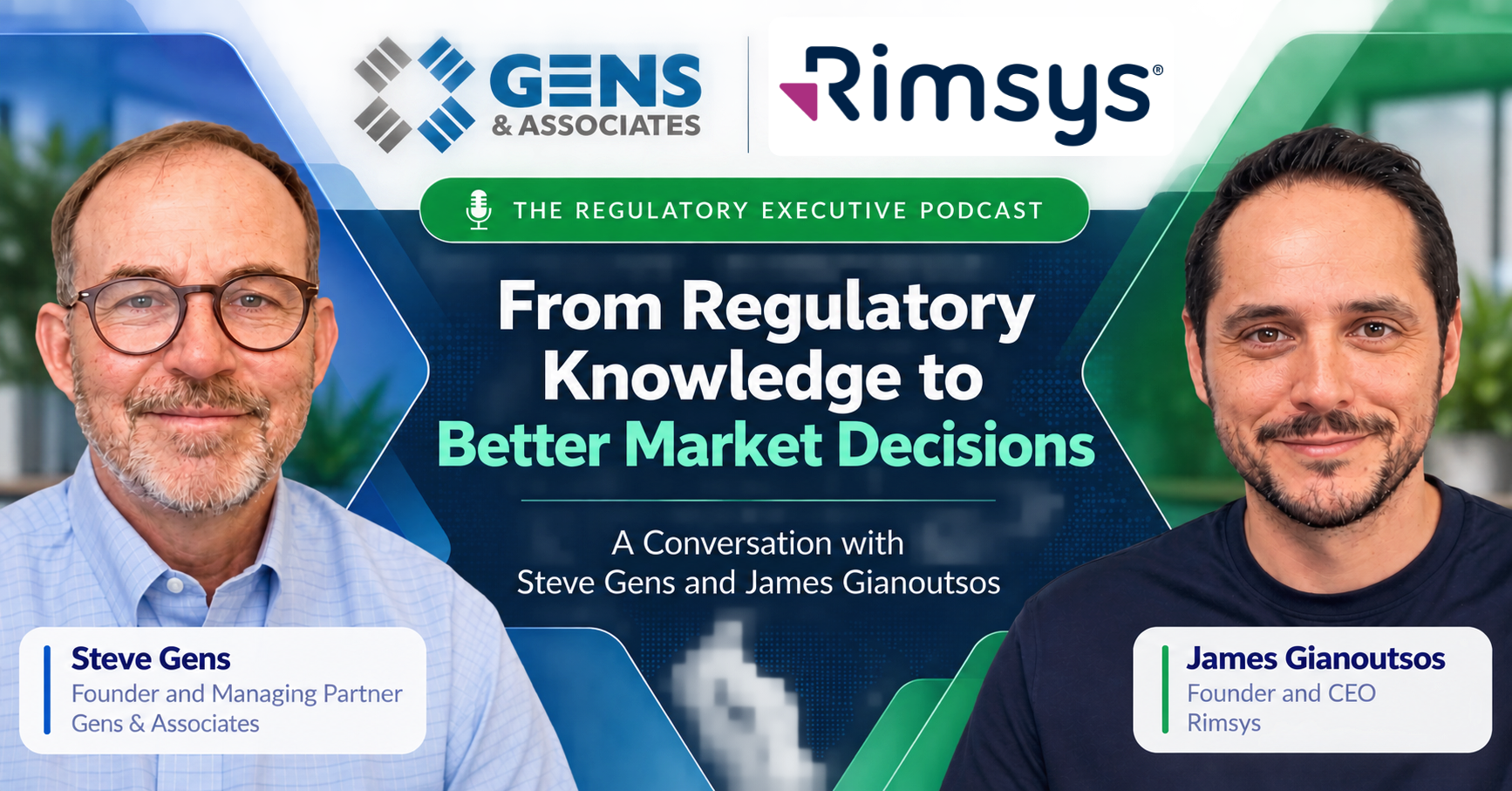
From Regulatory Knowledge to Better Market Decisions: A Conversation with Steve Gens and James Gianoutsos

October 1, 2026

4 min read

AI is moving quickly from experimentation to implementation across life sciences. For regulatory teams, that raises a bigger question than where AI can automate a task:

How can organizations use AI to make better decisions while maintaining the traceability, expert oversight, and confidence regulatory work demands?

That was a central theme when James Gianoutsos, Founder and CEO of Rimsys, joined Steve Gens, Founder and Managing Partner of Gens & Associates, on the Regulatory Executive Podcast.

Their conversation explored the changing role of regulatory intelligence, the introduction of Rimsys Market Access, the importance of transparency in regulatory AI, and what these changes could mean for regulatory teams.

Regulatory knowledge has been difficult and costly to scale

For global medtech organizations, regulatory knowledge has traditionally been highly dependent on people.

A company may have specialists responsible for particular countries or regions, along with local representatives, distributors, consultants, and other experts. Those people develop deep knowledge of local regulations, pathways, and expectations.

The problem is that the knowledge often remains distributed across the organization. And maintaining that market-by-market expertise can become expensive as a company expands its portfolio and geographic footprint.

As James described during the podcast, large manufacturers may rely on dozens or even hundreds of internal employees, third-party distributors, local representatives, and other specialists to understand what it takes to bring products into different markets. Smaller organizations may rely more heavily on outside consultants and partners. Either way, the model can be costly and difficult to scale. 

But the cost isn't limited to what companies spend on expertise.

Steve described the workflow as a series of “start, stop” cycles: ask a local expert, verify whether the regulation is current, gather more information, and repeat. Each cycle consumes regulatory capacity and extends the time it takes to give the business a confident answer.

That creates another potentially more consequential expense: the cost of waiting.

When it takes months to understand what entering a market will require, commercial and product teams have less visibility into when revenue might begin, what resources will be needed, or whether the opportunity is worth pursuing. Regulatory teams spend valuable capacity assembling and validating information rather than applying their expertise to more strategic work.

Ultimately, scaling regulatory knowledge isn't simply an efficiency problem. It affects how quickly and confidently the business can decide where to invest.

The bigger question: Should we enter this market?

That challenge is central to Rimsys Market Access.

Most market-entry research begins with questions such as: How is the product classified? What's the regulatory pathway? What are the requirements?

Those questions establish whether a company can enter a market. But they don't necessarily tell the business whether it should.

Market Access is designed to help regulatory and commercial teams develop an earlier view of what market entry could involve, including classification, regulatory pathway, timeline, cost considerations, requirements and potential gaps. 

For commercial and product leaders, that provides greater predictability before committing budget and resources.

For regulatory leaders, it means starting with a structured plan rather than assembling every market assessment from scratch.

Moving regulatory knowledge from individuals into a shared system

During the conversation, James described one of AI's most significant opportunities as moving knowledge that has historically lived in people's heads into software.

The goal isn't to eliminate regulatory expertise. It's to make that expertise more scalable.

Market Access works from a curated regulatory corpus, allowing market-specific knowledge to be applied across workflows without requiring every initial question to go through the individual who happens to know that jurisdiction. Outputs are designed to trace back to the underlying regulation, guidance, or law. 

That can also change where regulatory professionals spend their time. Rather than focusing as heavily on finding information and assembling initial assessments, they can focus on reviewing the evidence, identifying gaps, applying judgment, and advising the business.

Steve described the concept as a subject-matter-expert assistant. James called it a workforce multiplier. 

Trust requires opening the regulatory AI “black box”

Speed isn't enough when the information is being used to inform regulatory decisions.

James and Steve returned repeatedly to the importance of knowing where an AI-generated answer comes from. As Steve summarized it during the discussion, transparency builds trust.

Market Access is designed around that principle. Its outputs are grounded in a curated regulatory corpus and traceable to the specific regulations, guidance, or laws supporting them. That gives regulatory professionals the ability to verify an answer rather than simply accept it. 

Human judgment remains essential as well. Market Access provides an upfront assessment, not a guarantee of a regulatory outcome. Reviewer interpretation and other factors can still affect what happens during the regulatory process.

The objective isn't to make uncertainty disappear. It's to make what is known, what the sources say, and where uncertainty remains much easier to see.

Connecting the market decision to execution

The discussion also pointed to a broader evolution in regulatory technology: moving from systems that primarily store regulatory information toward systems that help teams act on it.

That's where Market Access and Rimsys RIM play distinct but complementary roles.

Market Access is the planning layer. It helps teams determine whether, when, and how to enter a market.

Rimsys RIM is the execution layer. It manages the registrations, submissions, regulatory changes, and ongoing regulatory work required to act on that plan. 

Together, they create a path from the initial market decision through regulatory execution rather than leaving planning and execution disconnected.

A new role for AI in regulatory work

One of the most interesting themes from Steve and James's conversation was that AI's impact may ultimately be less about replacing individual tasks and more about expanding what regulatory teams can accomplish.

Better access to market-specific knowledge can help professionals work across more markets, spend less time gathering information, and devote more capacity to the judgment and strategic work that requires their expertise.

The technology is changing quickly, but the fundamentals of regulatory work remain: reliable information, domain expertise, transparency, and human judgment.

The opportunity is to apply those fundamentals at greater scale while giving the business a clearer answer to the question that comes before execution:

Not simply, “Can we enter this market?”

But, “Should we?”

Listen to the full conversation

Hear the complete discussion between Steve Gens, Founder and Managing Partner of Gens & Associates, and James Gianoutsos, Founder and CEO of Rimsys, on the Regulatory Executive Podcast for more on regulatory AI, market-entry planning, transparency, and the changing role of regulatory teams.

‍

AI

How Market Access Builds Trust in Regulatory Intelligence

By

Bethaney Lentz

September 18, 2026

4 min read

Why source traceability, regulatory specificity, and human judgment matter when AI informs a market-entry decision.

Regulatory professionals are not short on AI options. General-purpose tools can answer questions quickly and often sound convincing. But in medtech, a convincing answer is not the same thing as a decision you can defend.

That distinction matters most before a company commits to a new market. Teams need to understand how a product is classified, which pathway applies, how long entry may take, what it may cost, where the important gaps are, and what uncertainty still remains. Commercial leaders need that visibility to decide whether the opportunity is worth pursuing. Regulatory leaders need to know that the assessment is grounded in sources they can verify.

That is the trust standard behind Rimsys Market Access. It is not simply about producing regulatory information faster. It is about helping medtech teams decide whether, when, and how to enter a market before committing budget and resources, with outputs linked back to the regulations, guidance, and laws behind them.

Why fluency is not enough for regulatory work

A general AI tool can be useful for brainstorming, summarizing, and exploring a topic. The challenge comes when an answer has real regulatory consequences. A plausible response may still be incomplete, based on the wrong designation, or disconnected from the current source that should govern the decision.

Medtech makes this especially difficult because the same product can be treated differently across markets and product designations. Medical device, IVD, cosmetic, consumer, OTC, and combination-product considerations can change the regulatory read. A market-entry assessment has to account for that context rather than assume one answer travels cleanly from one jurisdiction to another.

For regulatory teams, the natural next question is: Where did this answer come from? If the system cannot show the underlying authority, the expert still has to rebuild the research before trusting the result. That limits the value of the speed AI was supposed to create in the first place.

Trust starts with a decision you can verify

Market Access is designed around a different outcome. The goal is not to give teams another stream of regulatory information to interpret. It is to provide a source-linked market plan that helps them answer the bigger business question: should we enter this market, not just can we?

For a market assessment, that can include classification, regulatory pathway, timeline, cost considerations, key requirements and potential gaps. The output is designed to give commercial and product leaders an earlier, more defensible view of the opportunity while giving regulatory professionals the detail they need to review the basis for the assessment.

Trust comes from being able to inspect that basis. Market Access works from a curated regulatory corpus spanning more than 200 markets rather than relying on the open web. Answers are linked to the specific regulation, guidance, or law behind them, so a regulatory professional can verify the source instead of being asked to accept an AI-generated conclusion on faith.

Three things make regulatory intelligence more defensible

1. Source traceability

A regulatory answer is more useful when the person reviewing it can follow the evidence. Market Access links outputs back to their underlying regulatory sources. That changes the review process from “Do I trust the AI?” to a more practical question: “Does the cited source support this conclusion for our product and situation?”

That is an important shift for regulatory teams. Instead of assembling every market assessment from a blank page, they can review a structured, sourced plan, challenge assumptions, and focus their expertise on the places where judgment matters most.

2. Regulatory specificity

Trust also depends on context. Market Access is purpose-built for medtech regulatory complexity and supports cross-designation classification. The objective is to evaluate the product in the context of the market and the applicable regulatory framework, then carry that context into the pathway, requirements, timeline, cost considerations, and gaps that shape the market-entry decision.

This is where a purpose-built market-planning platform differs from a generic chat experience. The value is not an impressive answer in isolation. It is a connected assessment that helps the team understand what entering the market is likely to require and whether the opportunity still makes sense once those requirements are visible.

3. Human judgment stays in control

No system can remove every area of uncertainty from regulatory work. Reviewer interpretation and expert judgment still affect outcomes, and Market Access is not designed to promise approval.

Instead, Market Access is designed to make uncertainty more manageable. Regulatory professionals review and validate the work before it moves into execution. They can verify sources, assess the gaps, and apply company and product context that software cannot fully replace. The technology accelerates the research and planning. The regulatory professional remains responsible for the judgment.

What trust looks like in a market-entry decision

Imagine a team evaluating several markets for a new product. The commercial question is not simply whether registration is technically possible. The team needs to know which markets deserve investment now, which may require more evidence or resources, and which could put the revenue window at risk because the pathway is longer or more complex than expected.

Regulatory has a different, but connected, need. They have to understand the classification and pathway, identify the requirements most likely to slow the submission, and confirm that the plan reflects the relevant regulatory sources.

Market Access brings those views together. Commercial and product leaders get earlier visibility into timing, cost considerations, requirements, and risk so they can build a stronger business case. Regulatory teams get a source-linked plan they can review rather than a collection of unsupported conclusions. Both groups are working from the same market-entry picture before significant resources are committed.

Trust is not the end goal. Better decisions are.

It is easy for a conversation about regulatory AI to become a conversation about models, agents, or architecture. Those details matter, but they are not the business outcome.

The real value of trustworthy regulatory intelligence is what it lets a team do next. It can help a commercial leader defend a market investment. It can help regulatory surface issues earlier. It can give both groups a more predictable view of the work ahead before budget, R&D capacity, or launch timing is locked in.

And once the decision is made, the work does not have to stop at an intelligence report. Market Access is the market-planning layer. Rimsys RIM is the execution layer for registrations, submissions, regulatory changes, and ongoing regulatory work. Each can stand on its own, and together they create a path from the market-entry decision into controlled execution.

A more useful standard for regulatory AI

The question for medtech teams should not be whether AI can produce a regulatory answer. It can. The better question is whether that answer is specific enough, traceable enough, and reviewable enough to support a real decision.

Market Access is built around that standard: a defensible view of whether, when, and how to enter a market, grounded in curated regulatory sources and kept under human review. Because when the decision affects revenue, resources, and regulatory strategy, sounding right is not enough. Teams need to see why the answer is right, where uncertainty remains, and what it means for the decision in front of them.

I agree to the privacy policy including to Rimsys using my contact details to contact me for marketing purposes.
Thank you! Your submission has been received!
Oops! Something went wrong while submitting the form.
Hand holding smartphone showing email app with 12 unread messages notification.