Blogs

RIM

RIM 101: what is regulatory information management?

By

Michael Peach

November 1, 2021

4 min read

Regulatory Information Management (RIM) refers to a category of software solutions that are designed to support and streamline the activities of regulatory affairs (RA) teams. For most teams they are a net-new category of software, and generally replace manual processes that are paper-based or run using traditional productivity software (spreadsheets and docs). RIM systems first emerged to support pharmaceutical regulatory activities, but in recent years medtech-focused solutions have hit the market as well.

Given their general new-ness, especially for medtech RA teams, it’s not surprising that many teams are unfamiliar with the technology. In our, admittedly informal, survey of RAPS 2021 attendees, only 11% of respondents said they currently use a RIM system, and 33% had no knowledge of the category at all. This article provides some background on what RIM systems are, and what they do to help medtech RA teams operate more effectively.

Want to learn more? Watch our interactive video series

The role of regulatory affairs in medtech

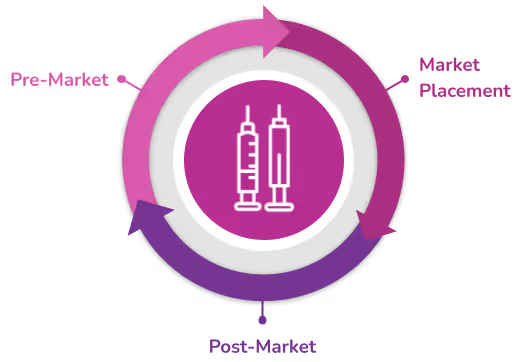
To understand RIM systems, first we have to look at the role of regulatory affairs. In medtech, which includes medical devices, in vitro diagnostics, and medical software, RA teams play a critical role across a product’s lifecycle.


Before products are released for sale, RA teams work closely with research and development (R&D) teams to ensure that a new product meets necessary local requirements to be legally marketed in the desired target markets. There are over 113 different regulatory regimes around the world that medical devices are subject to. While there are many similarities, RA teams must understand the nuances between countries and guide R&D to ensure that products are developed accordingly.

Once products obtain market clearance, RA teams switch to monitoring mode to ensure that products can remain on the market. This includes keeping track of expiration dates and certificates, any changes in regulations or international standards that could impact the product, and any changes in the product or it’s technical documentation. Health authorities in many countries regularly perform product audits, so keeping all information in order and up-to-date is an important part of regulatory work.

RA teams usually take the lead on post-market surveillance activities as well, working closely with their quality assurance (QA) counterparts. They track adverse events and complaints, compiling this information from public and internal sources, and ensure that the data is reported appropriately to health authorities. Not all markets require extensive post-market surveillance for medical devices, but these regulations are becoming more common. Both the EU and Canada have recently implemented expanded surveillance requirements including the need for regular summary reporting to continuously confirm product performance and safety.

The information challenge

All of the regulatory activities highlighted in the previous section are repeated for every individual product the company sells in every regulated country or region. And, all of these activities are highly dependent on specific information. To do their jobs effectively, medtech regulatory affairs professionals need insight into global regulations and standards, detailed product specifications, testing, performance, and safety data, and a full record of all regulatory registrations and processes.

The problem is that this information is often scattered across the company. It’s stored in multiple systems, (sometimes physical) documents, and individual employees’ heads. Because this information is so scattered, RA professionals can spend up to 50% of their time just looking for things, and simple requests such as identifying whether a product has clearance to be marketed in a specific country can take days to complete.

How RIM systems can help

At a fundamental level, RIM systems are about helping RA teams corral and manage all of the information they need to do their jobs. RIM systems serve as a “single source of truth” for RA teams. They store and manage regulatory documents, integrate with systems across the company, and create a traceable record of all regulatory activities. All of this information is linked to individual products and countries or regions, making it much easier to find.

All of the collected information in a RIM system can be used to streamline regulatory activities across the product lifecycle. Before products are released, they provide access to regulatory intelligence, including market entrance requirements, that RA teams can use to guide product development and regulatory submissions. RIM systems also provide a collaborative digital hub where teams can author and assemble supporting documentation for new regulatory submissions.

For products currently on the market RIM systems can monitor registration expiration dates, and track changes in relevant standards and regulations to identify potential product impacts. This automated monitoring can give RA teams an “early warning”, and allow them to accommodate changes that might impact the selling status of a product.

RIM systems can also help with post-market surveillance activities. They can collect and centralize post-market data analytics, and facilitate planning and active surveillance activities to meet the most current regulatory requirements. These systems can also ensure that actions and conclusions drawn from the post-market surveillance process are consistently applied throughout the quality management system. And, the same authoring capabilities used to assemble pre-market submissions can be used for post-market reporting and communication with regional regulatory authorities.

RIM capabilities across the regulatory lifecycle

Project planning, tracking, and management

Underpinning all of these capabilities is a full set of project features that allow RA teams to effectively manage and track their activities. This can include project request features that allow internal teams or 3rd-party partners such as local distributors to request specific regulatory activities or information. RIM systems also provide project task management, approval workflows, and digital signature capabilities that are fully auditable, and 21 CFR Part 11 compliant.

RIM systems also provide detailed reporting in the form of customized dashboards and registration, product, standards, and documentation reports. These reports offer at a glance monitoring of key information and detailed visibility into regulatory status and activities. For many teams this level of visibility is new, and allows them to fully measure, benchmark and report on their activities to company leadership.

The impact of RIM systems

RIM systems can have a tremendous impact on RA teams. By centralizing information they improve team productivity by ensuring that up-to-date information is always easily available and consistently applied. By automating workflows like new submission creation, or essential principles/GSPR table assembly they ensure that work gets done quickly and in-line with country/region requirements. RIM systems also provide more visibility into regulatory activities, allowing teams to benchmark and more accurately forecast the time required for new market clearance, and other product milestones.

To the company, the increased regulatory efficiency and effectiveness means reduced revenue risk from noncompliance or having to pull products from market, stronger, more confident global regulatory compliance, and ability to get new products to market much more quickly.

To learn more about RIM systems, their key capabilities, and if your organization could benefit from bringing one onboard, read our RIM System Buyer’s Guide for Medtech Companies.

Similar posts

Registration deadlines don't have to be a risk. See how centralized data, automated alerts, and standardized workflows keep global registrations on track

MedTech

RIM

Product Updates

How to Prevent Registration Deadline Misses in 2026

By

Bethaney Lentz

August 4, 2026

4 min read

A missed registration deadline can halt sales, trigger regulatory penalties, and damage your organization's credibility with health authorities. For MedTech regulatory affairs teams managing hundreds or thousands of product registrations across dozens of markets, preventing deadline misses requires more than calendar reminders. It demands structured data, clear workflows, and real-time visibility into expiration timelines.

This guide explains why registration compliance deadlines are missed and how your team can prevent delays through stronger data control, workflow visibility, and process standardization.

Key Takeaways: How to Prevent Registration Deadline Misses in 2026
  • Registration deadline misses typically stem from fragmented data, unclear ownership, and siloed communication between teams.
  • Proactive renewal management requires real-time visibility into expiration dates across your entire global product portfolio.
  • Standardized workflows with assigned accountability eliminate the confusion that leads to overlooked deadlines.
  • Rimsys centralizes registration data and automates renewal alerts, reducing the risk of missed deadlines by up to 90%.
  • Investing in a purpose-built RIM platform protects revenue continuity and maintains uninterrupted market access.

Why Do MedTech Teams Miss Registration Compliance Deadlines?

Registration deadline misses  occur because the operating model cannot scale with growing portfolio complexity. Understanding root causes is the first step toward prevention.

  • Fragmented Data Across Systems and Regions

Many organizations track registrations using disconnected regional trackers, shared drives, and individual team member records. When product data lives in multiple locations, no single source of truth exists. This fragmentation makes it difficult to identify upcoming expirations before they become urgent.

A registration that expires in Brazil may be tracked in one system while the same product's EU approval is monitored elsewhere. Without connection between these records, teams lack portfolio-wide visibility into renewal timelines.

  • Unclear Ownership and Accountability

When responsibilities are distributed across regional leads, in-country partners, and distributors without clear accountability structures, deadlines fall through the cracks. Team members may assume someone else is handling a renewal, leading to inaction until the deadline passes.

Organizations with high turnover face additional risk. When key personnel leave, institutional knowledge about pending renewals often leaves with them.

  • Reactive Tracking Instead of Proactive Management

Calendar-based reminders and email notifications are inherently reactive. By the time a reminder appears, teams may not have enough runway to gather required documentation, coordinate with authorities, or address unexpected complications.

Effective deadline management requires proactive monitoring that surfaces upcoming expirations months in advance, not days before they occur.

What Happens When Registration Deadlines Are Missed?

The consequences of missed registration deadlines extend beyond administrative inconvenience. They create tangible business disruptions that affect revenue, reputation, and regulatory standing.

  • Loss of Market Access and Revenue Disruption

An expired registration means your product cannot legally be sold in that market. Regulatory teams must halt shipments, distribution partners cannot fulfill orders, and revenue stops flowing. For high-volume products or critical markets, even brief interruptions to the supply chain can translate to significant financial impact.

Re-registering a lapsed product often takes longer than a standard renewal. Your team may face additional scrutiny, updated documentation requirements, or queue delays that extend the time to market restoration.

  • Regulatory Penalties and Increased Scrutiny

Health authorities track compliance history. Missed deadlines signal operational weaknesses that can trigger increased inspection frequency, additional documentation requests, or enhanced scrutiny on future submissions. Building trust with regulators takes years; eroding it takes one avoidable miss.

  • Damage to Distributor and Partner Relationships

In-country partners and distributors depend on your organization to maintain valid registrations. When market access lapses, partners bear the burden of explaining delays to healthcare providers and end customers. Repeated misses can damage long-term business relationships and competitive positioning.

How to Identify Products at Risk of Deadline Misses

Prevention starts with identifying which registrations are most vulnerable. A systematic risk assessment helps teams prioritize attention and allocate resources effectively.

  • Create a Consolidated Registration Inventory

Bring all registration data into a single view. Include product identifiers, registration numbers, approval dates, expiration dates, responsible parties, and market-specific requirements. This inventory becomes your foundation for risk assessment.

Rimsys Registration Software centralizes this data automatically, linking registrations to products, submissions, and regulatory intelligence in one structured system.

  • Segment by Expiration Timeline and Complexity

Not all renewals carry equal risk. Categorize registrations by time remaining until expiration and by the complexity of renewal requirements. Products expiring within the next 90 days with extensive documentation needs should receive immediate attention.

Consider country-specific factors. Some markets require local testing, updated clinical data, or notified body involvement. These requirements extend lead times and increase the risk of delays.

  • Assess Documentation Readiness

For each at-risk registration, evaluate whether required documentation is current and accessible. Outdated technical files, missing test reports, or incomplete labeling information create bottlenecks that delay renewal submissions.

Documentation gaps discovered weeks before a deadline often cannot be addressed in time. Early assessment ensures enough runway to resolve issues.

Building a Proactive Renewal Management System

Moving from reactive tracking to proactive management requires intentional process design. The following components form the foundation of an effective renewal management system.

  • Establish Clear Ownership for Every Registration

Assign a single accountable owner for each registration. This person is responsible for monitoring expiration timelines, coordinating renewal activities, and escalating issues that require additional support.

Ownership should be documented within your registration management system, not stored in separate organizational charts or email threads. When someone leaves the organization, ownership transfer becomes straightforward.

  • Define Standard Lead Times by Market and Product Type

Different markets have different renewal timelines. EU MDR renewals involve notified body coordination. FDA establishment registrations follow annual cycles. ANVISA submissions may require specific local documentation.

Document the standard lead time needed for each market and product type. Use these lead times to trigger renewal workflows well before deadlines approach.

  • Implement Automated Expiration Monitoring

Replace manual calendar tracking with automated monitoring that surfaces upcoming expirations across your entire portfolio. Alerts should trigger at multiple intervals, such as 180 days, 90 days, 60 days, and 30 days before expiration.

Automated monitoring ensures that no registration is overlooked, regardless of portfolio size or team bandwidth. Rimsys Global Regulatory Compliance capabilities include lifecycle tracking and automated alerts that reduce missed renewal risk.

Standardizing Workflows to Prevent Oversight

Consistent workflows eliminate the variability that leads to deadlines. When every renewal follows the same structured process, teams can identify and address deviations before they cause problems.

  • Create Renewal Workflow Templates

Define the steps required for each type of renewal. Include documentation gathering, internal review, submission preparation, authority submission, and post-submission tracking. Assign responsible parties and expected durations for each step.

Templates ensure that new team members can execute renewals correctly without relying on undocumented institutional knowledge.

  • Build Escalation Paths for Delayed Activities

Not every renewal proceeds according to plan. Documentation may be delayed. Authority responses may take longer than expected. Partners may fail to submit required local information.

Define clear escalation paths that activate when activities fall behind schedule. Escalation should be automatic and visible, not dependent on individual team members raising concerns manually.

  • Conduct Regular Pipeline Reviews

Schedule recurring reviews of your renewal pipeline. During these reviews, examine registrations approaching expiration, identify any blocked activities, and confirm that responsible parties are on track.

Pipeline reviews surface potential issues early, when corrective action is still possible. They also reinforce accountability by making renewal status visible to leadership.

How Data Control Reduces Deadline Risk

Strong data control is the foundation of reliable deadline management. When registration data is accurate, current, and accessible, teams make better decisions and avoid preventable misses.

  • Maintain a Single Source of Truth

Eliminate competing data sources by establishing one authoritative system for registration information. All team members, partners, and stakeholders should access the same data, ensuring consistency and reducing confusion.

A single source of truth means that when someone asks about a product's registration status in a specific market, the answer is immediate and reliable. No cross-referencing multiple trackers. No waiting for colleagues to respond to email inquiries.

  • Connect Registration Data to Product and Submission Records

Registrations do not exist in isolation. They connect to specific products, rely on previous submissions, and may be affected by regulatory changes or product modifications. Systems that link these data types enable more accurate impact analysis.

When a product design change occurs, connected data helps teams identify which registrations may need updated. When regulations evolve, linked intelligence shows which markets and products are affected.

  • Ensure Version Control and Audit Readiness

Regulatory authorities expect organizations to demonstrate controlled processes. Maintain version history for all registration-related documentation. Track who made changes, when changes occurred, and what was modified.

Audit readiness built into daily operations means less scrambling when inspections occur. It also shows the historical context needed to understand how registration status evolved over time.

Leveraging Technology for Visibility and Automation

Technology plays a critical role in scaling deadline management across large portfolios. Purpose-built regulatory information management platforms offer capabilities that generic tools cannot match.

  • Dashboard Visibility Across Global Markets

Executive and operational dashboards display at-a-glance visibility into registration status across your entire portfolio. Filter by market, product line, expiration timeline, or responsible party, to focus on relevant subsets.

Dashboard visibility enables leadership to ask and answer questions quickly:

  • How many registrations will expire in the next quarter?
  • Which markets have the highest concentration of upcoming renewals?
  • Are any renewals currently blocked?
  • Automated Alerts and Notifications

Configure alerts that notify responsible parties when action is required. Notifications should be specific, actionable, and timely. Rather than generic reminders, alerts should identify the specific registration, required action, and deadline.

Effective notification systems reduce the cognitive burden on team members. Instead of tracking deadlines mentally, they receive prompts when attention is needed.

  • Reporting for Continuous Improvement

Track metrics that indicate process health. Monitor the number of registrations renewed on time, average lead time utilization, and frequency of expedited renewals. Use these metrics to identify process weaknesses and drive improvement.

Organizations that measure renewal performance can demonstrate compliance maturity to regulators, partners, and investors. Metrics also help justify investments in process improvement.

How Rimsys Helps Prevent Registration Deadline Misses

Rimsys is the first and only holistic Regulatory Information Management software purpose-built for MedTech. It centralizes registrations, submissions, regulatory intelligence, and UDI data in one connected platform, giving teams the visibility and automation needed to prevent deadline misses.

  • Centralized Global Registration Tracking

Rimsys maintains a structured, product-centric data model that connects registrations to products, markets, and submissions. Teams gain real-time visibility into where every product can be sold, which registrations are pending, and which are approaching expiration.

Six of the world's top 12 MedTech manufacturers trust Rimsys to manage global regulatory operations, achieving up to 90% reduction in reporting effort and elimination of manual tracking risk.

  • Automated Lifecycle Alerts

Rimsys monitors registration lifecycles and automatically alerts teams to upcoming expirations, renewals, and information requests. Automated alerts ensure that no registration is overlooked, regardless of the portfolio size.

With Rimsys AI, teams can accelerate regulatory work through AI-assisted workflows that reduce repetitive tasks while keeping human judgment in control.

  • Connected Regulatory Intelligence

Registration deadlines do not exist in isolation from regulatory change. New requirements can affect renewal timelines, documentation needs, or market access conditions.

Rimsys connects registration data to regulatory intelligence and impact assessment workflows, helping teams understand how changes affect their portfolio before deadlines become urgent.

Creating a Culture of Deadline Accountability

Technology and process alone do not prevent deadline misses. Organizations must also cultivate a culture where deadline accountability is valued and reinforced.

  • Make Renewal Performance Visible

Share renewal metrics with teams and leadership regularly. Celebrate on-time renewals and analyze near-misses to identify improvement opportunities. Visibility creates accountability without requiring punitive measures.

  • Invest in Team Training and Development

Ensure that team members understand the importance of deadline management and have the skills to execute renewal workflows effectively. Training should cover both procedural requirements and the business impact of missed deadlines.

  • Support Cross-Functional Collaboration

Registrations often require input from quality, engineering, labeling, and commercial teams. Foster collaboration across functions to ensure that dependencies are identified early and addressed proactively.

When regulatory affairs teams operate in silos, they lack the information needed to anticipate complications. Cross-functional visibility enables earlier intervention.

In Conclusion: How to Prevent Registration Deadline Misses

Preventing registration deadline misses requires intentional effort across three dimensions: data control, workflow visibility, and process standardization. Organizations that invest in these areas protect revenue continuity, maintain regulatory standing, and preserve partner relationships.

The complexity of global regulatory operations is not slowing down. As portfolios expand and requirements evolve, teams need infrastructure that scales. Rimsys transforms regulatory operations from administrative tracking into strategic enablement, bringing speed, visibility, and confidence to global expansion.

Ready to eliminate deadline risk from your registration management? Speak with the Rimsys team to see how leading MedTech manufacturers manage global registrations with precision and control.

References:

How Smith & Nephew Repositioned Regulatory as a Strategic Commercial Partner

MedTech

RIM

How Smith & Nephew Repositioned Regulatory as a Strategic Commercial Partner

By

Caroline La

May 28, 2026

4 min read

Smith & Nephew is a global medical device manufacturerwith a broad portfolio spanning orthopedics, sports medicine, and woundmanagement, sold and registered across markets worldwide. Before Rimsys,regulatory data was scattered across spreadsheets, shared drives, anddisconnected systems.

When Smith & Nephew selected Rimsys, they deployed enterprise-wide from day one. Executive reporting moved from manual fire drills to real-time dashboards. Change impact assessments became faster and more consistent. The regulatory team made the shift from reactive compliance function to strategic partner to the business.

The Challenge

Regulatory data at Smith & Nephew lived in multiplespreadsheets, shared drives, SharePoint sites, emails, and disconnectedsystems. Without a centralized record, the team could not reliably trackregistration timelines, measure on-time submissions, assess change impacts, orunderstand the downstream impact of product changes across markets. Preparingexecutive reporting meant manually assembling data from multiple sources, aprocess that consumed time and introduced risk each time.

The Solution

Smith & Nephew selected Rimsys for its configurable, notcustomized, platform: an intuitive user interface, centralized submissionmanagement, robust metrics, change assessment capabilities, and UDI supportwith machine-to-machine transmission. Rimsys’ interconnected modulearchitecture linked products, registrations, projects, change assessments, andUDI in a centralized location.

Rather than piloting in one business unit, Smith &Nephew deployed Rimsys across the entire regulatory organization from day one.The decision was deliberate: a partial deployment would have preserved thefragmentation. Enterprise-wide adoption established consistent metrics,standardized processes, and a single source of truth from the start.

The Results

Executive and board reporting, previously built from manualdata pulls, now flows directly from Rimsys in real time. What had been adisruptive, recurring effort is now a routine view. Leadership has thevisibility to make faster, more confident decisions, and the regulatory team isno longer pulled into reporting fire drills.

Change management has also been transformed. Direct linkagebetween products, registrations, and projects means impact assessments arefaster and less dependent on individual knowledge. UDI operations havesimilarly improved: machine-to-machine transmission has reduced manual uploadsand centralized DI record visibility supports global UDI requirements.

The most significant shift is strategic. With centralizedregulatory intelligence and real-time data, Smith & Nephew’s regulatoryteam now actively supports commercial planning: informing budget cycles,guiding renewal and launch sequencing, and advising on regulatory pathways toaccelerate market entry. Regulatory is no longer a downstream compliancefunction. It is a business partner.

Smith & Nephew now runs four modules across its RIM operation:

  • Registrations— Centralized license tracking across 250 countries and 30+ business units
  • Change Assessments— Direct product-registration linkage for faster, consistent impact assessments
  • Executive Reports— Real-time dashboards replacing manual data pulls and board reporting fire drills
  • UDI— Machine-to-machine transmission reducing manual uploads across global markets

Take this to your team

If you’re evaluating how to modernize RIM operations at scale, the Smith & Nephew case study is a practical reference to share internally. It covers the full implementation story, module breakdown, and results data in a format built for stakeholder conversations.

Download the Case Study

MedTech

RIM

How Philips Scaled Active Product Registrations More Than 20x

By

Caroline La

May 21, 2026

4 min read

Philips Healthcare operates one of the largest regulatory portfolios in global MedTech: products registered across 250 countries, with a footprint that grows with every acquisition. Before Rimsys, that complexity was managed through email and spreadsheets. Submission packages moved through inboxes with no audit trail, no performance data, and no reliable view of where products were authorized to ship.

Philips selected Rimsys in 2022 as the enterprise RIM platform to bring regulatory order to that complexity. Since go-live, active product registrations have scaled more than 20x, user adoption has doubled in the last six months, and the regulatory affairs function now operates from a single source of truth spanning the entire enterprise.

The Challenge

Without structured data, Philips could not measure regulatory performance, track license expiration across the portfolio, or identify where submission work was stalling. Every acquisition made it worse: incoming business units arrived with their own workflows and systems, absorbing more fragmentation rather than resolving it.

The Solution

Philips evaluated multiple platforms against requirements built with both market-facing and business regulatory affairs teams. Rimsys won on two dimensions: an interface that made complex product and registration data immediately visible, and more enterprise-ready features than competing platforms at the right price point.

Philips went live with Rimsys Registrations and Submissions modules in July 2022. The team deployed platform experts for train-the-trainer sessions and launched regular drop-in sessions where users could ask questions and surface issues. Standing up a dedicated Regulatory Operations team focused exclusively on rest-of-world registration accelerated adoption further.

When an early business unit pushed back on workflow efficiency, Philips and Rimsys worked through it together. A hands-on process walkthrough identified exactly what needed to change, a resolution plan was shared, and that transparency and collaboration became the foundation for sustained user buy-in across the enterprise.

The Results

Since go-live, Philips has scaled active product registrations more than 20x, with further growth already underway. What started as a single deployment now spans 30+ business units across 250 countries, with Rimsys serving as the single source of truth for regulatory data across the enterprise, including businesses acquired since implementation.

For the first time, Philips can measure its own regulatory performance. KPIs flow directly from the platform, giving leadership real-time visibility into registration health. When anomalies surface, they drive data correction and user training, closing gaps that previously went undetected until they affected revenue.

Now with Rimsys AI-assisted Submissions and Regulatory Intelligence now in use, Philips expects to accelerate further: reducing administrative burden so skilled regulatory professionals can focus on strategy.

Philips now runs four modules across its RIM operation:

  • Registrations— Centralized license tracking across 250 countries and 30+ business units
  • Submissions— AI-assisted submission workflows replacing email-based package management
  • Intelligence— Real-time KPI dashboards giving leadership visibility into registration health
  • Standards— Essential Principles and standards tracking aligned to global market requirements

Take this to your team

If you’re evaluating how to modernize RIM operations at scale, the Philips Healthcare case study is a practical reference to share internally. It covers the full implementation story, module breakdown, and results data in a format built for stakeholder conversations.

Download the Case Study

I agree to the privacy policy including to Rimsys using my contact details to contact me for marketing purposes.
Thank you! Your submission has been received!
Oops! Something went wrong while submitting the form.
Hand holding smartphone showing email app with 12 unread messages notification.