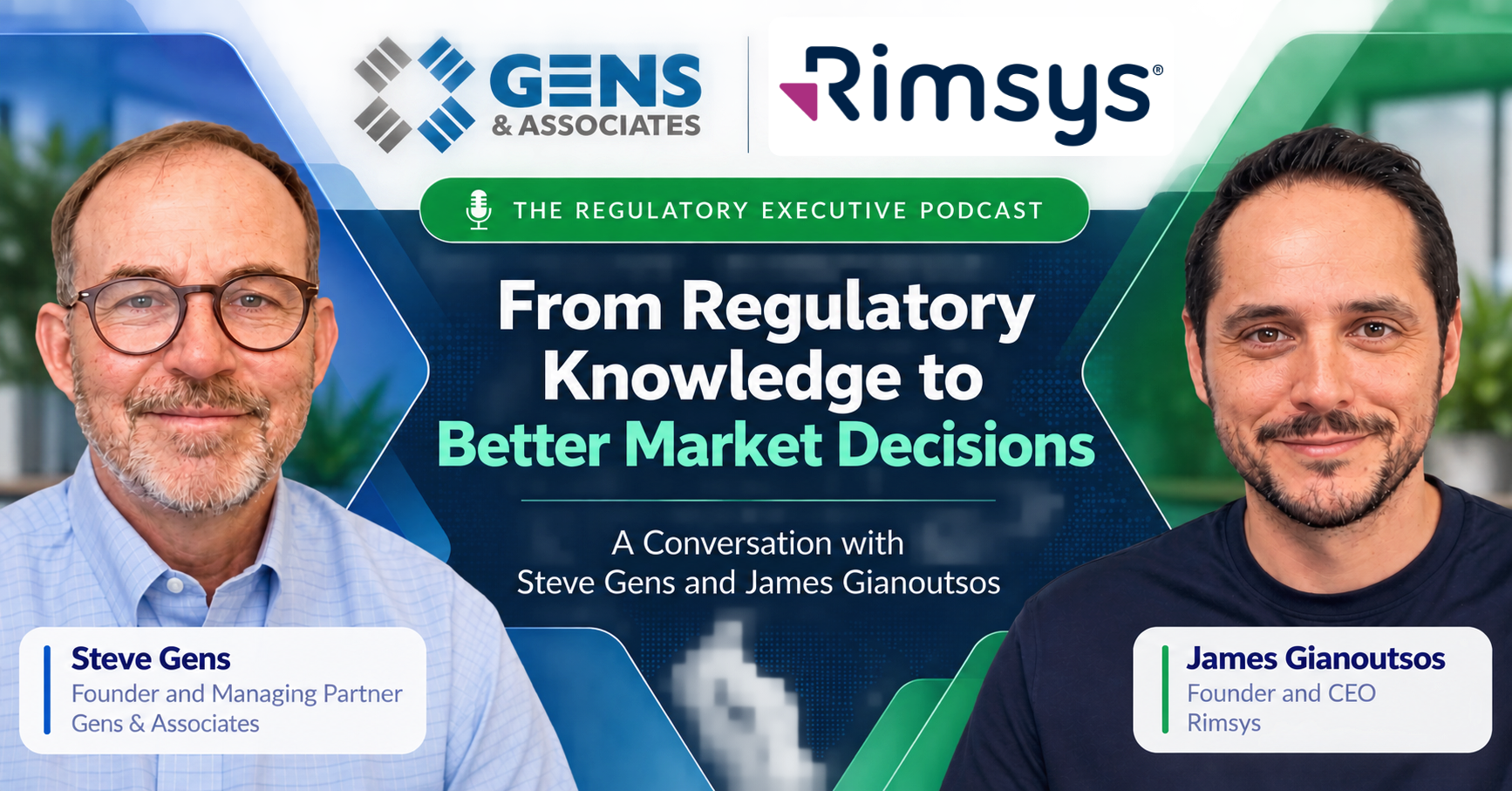
Rimsys Founder & CEO, James Gianoutsos, was recently a guest on the Gens and Associates Podcast, a series dedicated to regulatory trends, topics, and insights from industry thought leaders. During the interview, James and Gens and Associates Managing Partner, Steve Gens, shared their unique founding stories and discussed digital transformation in the medtech industry.
One particular aspect James and Steve discussed is the role of AI in medtech regulatory affairs. Historically, the medtech industry has lagged behind pharma in digital adoption by 10-15 years. As the medtech industry takes on digital transformation initiatives, some medtech companies pursue AI solutions first. Through his extensive experience helping medtech companies embrace and adopt digital change, James states the importance of starting with efficient regulatory information management. Listen to the full interview to learn why setting a proper data foundation is critical to leveraging AI successfully along with:
- How AI will evolve in medtech regulatory affairs
- The importance of data governance in medtech digital transformation
- Why partnering with a medtech-focused RIM provider like Rimsys is essential for a successful transformation
- What's next on the Rimsys product roadmap as the company enters its next phase of growth, including enhancements to Rimsys Intel
Find the full interview on the Gens and Associates website, Spotify and Apple.
We'd like to thank Gens and Associates for featuring James and for the opportunity for him to share his thoughts about medtech digital transformation with the Gens and Associates community!
About Gens and Associates
Gens and Associates is a boutique Life Science management and organizational consultancy specializing in strategic planning and roadmap development, industry benchmarking, regulatory information management, organizational transition management, and working with leadership and project teams to accelerate change and value realization. Learn more on the Gens and Associates website.
TRANSCRIPT:
Steve Gens: Welcome to the gens, an associates executive podcast series where I have one-on-one conversations with leading executives that represent the Regulatory software and services sector, to learn more about how their organizations are supporting, and more importantly innovating this space. So, Steve gens here, managing partner of Gens and Associates today, I'm happy to be speaking with James Gianoutsos, founder and CEO of Rimsys. So welcome, James, I've been looking forward to this conversation and, you know, as we have this executive series, it's kind of rare to have a founder, you know, founding Gens and Associates in 2005, seemed like a very risky proposition and it's different when you're founding something versus just being a CEO of existing organization. So, before we get started with Rimsys being a fairly new company, I think you were founded in 2017. Could you give our listers a brief history of Rimsys and yourself and how you support the me tech sector?
James Gianoutsos: Yeah, absolutely. And before I start off, just thanks for having myself on board and being a presenter here. And yeah, for everybody who does not understand the med tech arena or know Rimsys, my name is James Gianoutsos on founder and CEO of Rimsys. And I've spent the last 17 plus years in the Regulatory and quality industry.
And so I started my career at Philips and worked for several small and medium sized medtech manufacturers. I've had, the experience of actually managing global Regulatory operations, doing global submissions, moving 600,000,000 dollar manufacturing locations under consent decrees in the midst of the EU MDR and I VDR transitions. And so I've also had a really nice breadth, of medtech background as well, medtech product background, I should say all the way from c- pap devices to internal surgical adhesives even on the consumer side such as pacifiers, incubators, you name it.
I've really had a really diverse in broad experience level with medtech itself. And so back in 2017, I was actually working for a small medtech manufacturer. And fortunately, unfortunately, I was laid off of that position. It was something that I know that there's a lot of medtech manufacturers that are kind of doing the same thing in this year last year, I should say. And… and it was, you know, that would happen on May 31, 2017, at noon and I started Rimsys at 1 PM that same day. It was just something that I've always had in the back of my mind's something that I always wanted to pursue.
And really looking at the landscape back then there were only pharmaceutical RIM providers on the market. And so there was nothing really catered to, the medtech industry. Medtech and pharma aren’t uniform and aren’t just worlds but universes apart in terms of regulatory complexity, how you get products to market, how you maintain those products on the market and just the regulatory pathways and workflows around that. And so really started my endeavor hiring a couple developers offshore.
And, and to your point, you know, it's definitely different to be a founder than just a CEO because you're so heavily invested and so heavily involved that's you know, over the last five to six years… seven years is to say it's been a really cool experience to be personally involved with this development and working with the largest tech manufacturers in the world to help develop our solution and improve the regulatory workflows. So at the end of the day, they can get the products to market faster and keep those products on the market.
Steve Gens: Excellent. So thank you so much for that good introduction. And then again from one founder to another, I still remember I had a fold up desk in a spare room with a laptop, my cell phone, you know, one customer, one contract and, you know, we're starting our twentieth year and have over 100 global customers. Like, I could never imagine back then where it would be but, you start someplace, you have a vision, you see a need, you go after it. You, you just get the best team around you and you just do it. So, so congratulations, you had a very successful lift off, and that's where I'd like to start.
I know when we first got introduced and started covering you about four years ago. And, I think it's on your website too is, you know, that context because again, we support both the biopharmaceutical and tech and they are very different although there's growing combinational products, right? So they're starting to be a little worrying, but there they are two different worlds or universes. Kind of in your case, you know, I know you say, yeah, we build this by Regulatory affairs, you know, professionals, there's a better way to do this. And also like the other terminology that a lot of people use big words like transformation and all that. But in Regulatory, it's a major monetization and simplification. And I know on the medtech outside, organizationally you know, they tend to be a lot more distributed design center. So in some ways you have a different set of complexity. So we've been tracking you for about four years now, we've watched your growth. We get those regular annual updates, but I think one thing our customers would really be interested in is, you know, why do your customers pick Rimsys? You know, what differentiates you from, the competition?
James Gianoutsos: Yeah, there's a lot to unpack from that question. And I'm, happy to dive in a little bit more to it. You know, one of the primary things that we do and understand is the medtech industry period. And so from day one, you know, this is why our company exists to support medtech. There's you know, the whole thesis around Rimsys around our solution and our product, in the industry historically medtech is 10 to 15 years behind pharma from a digital transformation standpoint.
Medtech has been undergoing this digital transit initiative over the last several years and since then, we've really taken off because especially at the enterprise level standpoint, and the complexity around the workflows, the understanding of how the, in relation between the data elements of not just, you know, regulatory information, but of how the products are associated to those registrations to certificates to really all the entire Regulatory product life cycle really differentiates us because, we understand, those nuances better than anybody in the industry period.
You know, we've a we've had a lot of success because it feels like, the pharma industry is kind of waking up to it. We've actually seen some pharma companies try to come into medtech and actually failed miserably because, you know, I would say with 100 percent conviction that nobody wants a pharma RIM with the medtech label slapped onto it. And what allows us to be successful in that is that we partner deeply with our enterprise customers to understand those nuances, and we're adaptable to those changing regulatory needs. We are a relatively young company. But we are broadly and vastly experienced in that med tech space. And so that's really been one of our competitive advantages is just understanding the space like nobody else.
And you mentioned combination products and what's really unique about medtech is that, you know, combination products at the end of the day are a drug coded stint or some type of prefilled syringe, those are a medical device. And based on the primary mode of action, some other items that are typically more medtech forward devices. And so that creates an interesting opportunity for Rimsys because, you know, drugs are drugs at the end of the day, it might have different dosages, but the varying aspects of where that do can be put into the system or put into your system. I should say… your body is vast and a lot of those have or need a medical device to deliver that.
And so, the variations and complexity around that makes for Rimsys to be at the forefront and leader of that combination product standpoint. And a lot of our customers have actually adopted Rimsys even more heavily because of that, not just on the medtech side but on combination side.
Another interesting item that we're seeing is that we are also because medtech as it is so vast and so complicated and complex from the workflows. You know, we're product centric and that has the adjacent categories as well where you can go into veterinary biocides, biologics consumer side combination because at the end of the day, the framework in the structure is generally the same. However, the regulatory pathways might be different. And so, that bodes well with our client base because a medical device manufacturers product portfolio, is ever-changing but also becoming more broad in nature as it expands itself into its new markets.
Steve Gens: Yeah. Thanks for that overview. And I've been taking some notes on that. And I've seen kind of on the biopharmaceutical side, some of the RIM providers, hey, we should do medtech and, you know how I maybe I'm looking at this naive is like in the biopharmaceutical generics, you know, it's more of a data paradigm where, your life is an engineering paradigm and as opposed to like one to one with the health ministry or the health authority, you could have one to many in each country, right?
James Gianoutsos: Precisely.
Steve Gens: In your submission, so it's that extra kind of permutation if you will of complexity and maybe another podcast, maybe we'll do later on too. I was just thinking about, you brought up the stint in earlier in my career. I think, you know, I was a Johnson and Johnson guy and one day, you know, one of the pharma scientists was, you know, talking with one of the device scientists and they came up with a stint that must be like 20 years ago. But maybe another conversation, just the emergence of software as a device. You know, that's a big interesting topic. But that's venture on a little bit more so.
And I know we talked about this kind of, the other day, you know, about monetization of regulatory systems and processes. And there's such an intense focus. The big word this day is AI, right? But there's AI and automation, and sometimes people confuse, the two. What's Rimsys doing as far as helping your customers, and maybe just in the very near term. So maybe tactical things we're you're doing either with AI or automation or the combination. And what does the longer term look like?
James Gianoutsos: Yeah, it's a great question. And to your point, I think there's a couple items that, I specifically want to address there because at the end of the day, you know, AI, is this thing that's being used from a marketing standpoint or just from a general industry standpoint in general, right? And it's this idea that these systems or software solutions can help do the work for you. Not, you know, it's not gonna take anybody's job, but there are ways that it can definitely help make you more efficient.
You know, what's particularly interesting in the medtech digital digitalization transformation initiative that's going on right now is that, you know, medtech in itself is 10 to 15 years behind the times period. And so especially with these large enterprise level companies. And so, when you're in a horse and buggy, which is what the med tech industry is today. And we're trying to get into a spacecraft, of course, I think, the logical and the initial item in thinking is that, okay, we can just go straight to AI, but really at the end of the day AI is only as good as the data that is trained on.
And… phase one of the company has always been the information management period of medtech in the organization. In getting that, right, we've invested so much time and money and collaboration with our partners of how product attributes, UDI attributes, regulatory… attributes. And how all of that plays well and interlays with one another because if you don't get that fundamental framework, you're gonna have a hard time. You might do some really interesting things with AI, but you're gonna have a hard time keeping that information organized in the manner that you will need to have it organized to do things later on.
And so, what's really been interesting is that we're about complete with our phase one of the company, meaning that the information and organization and complex workflows have a majority of that has been addressed, meaning that we have now reached this pinnacle where we're gonna go into phase two of Rimsys.
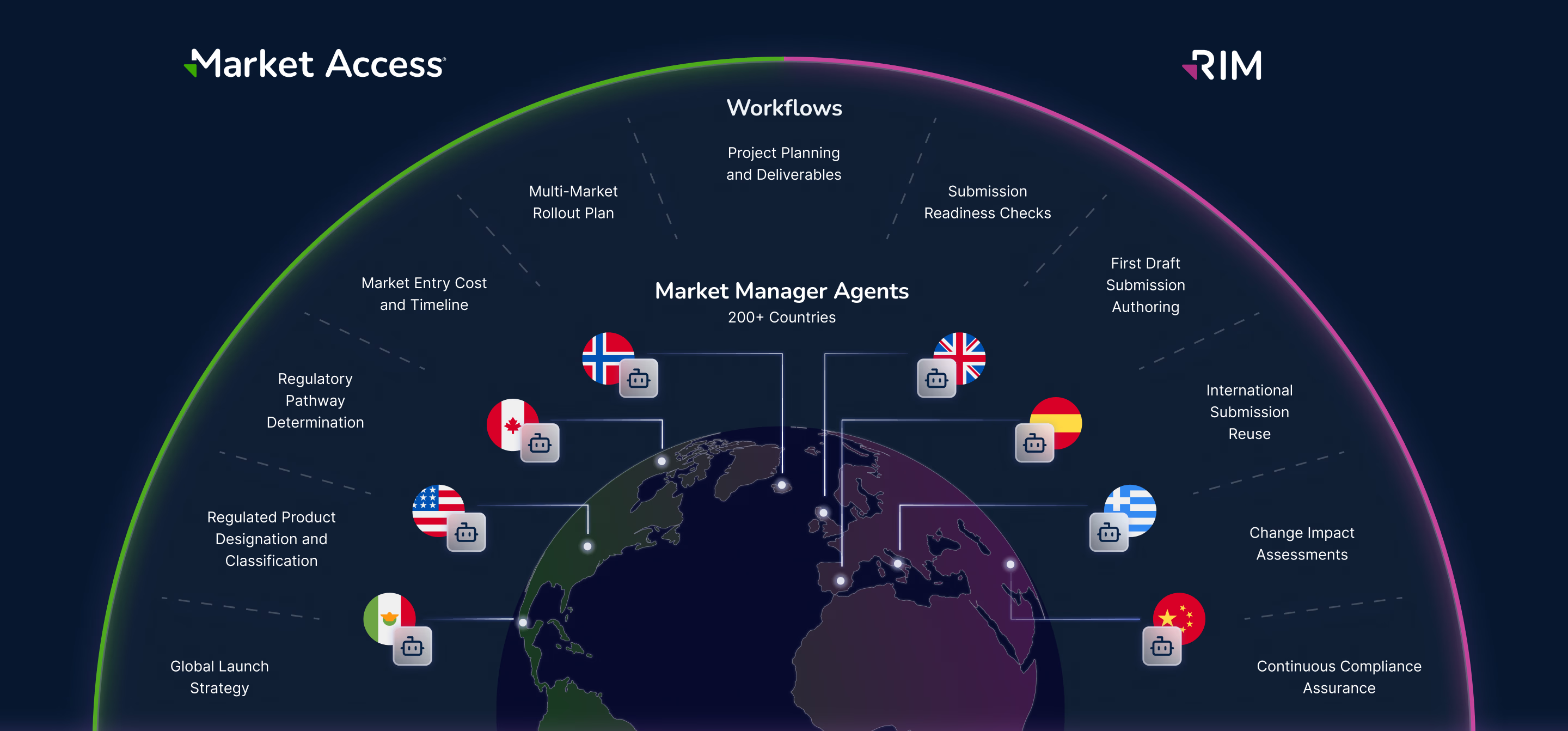
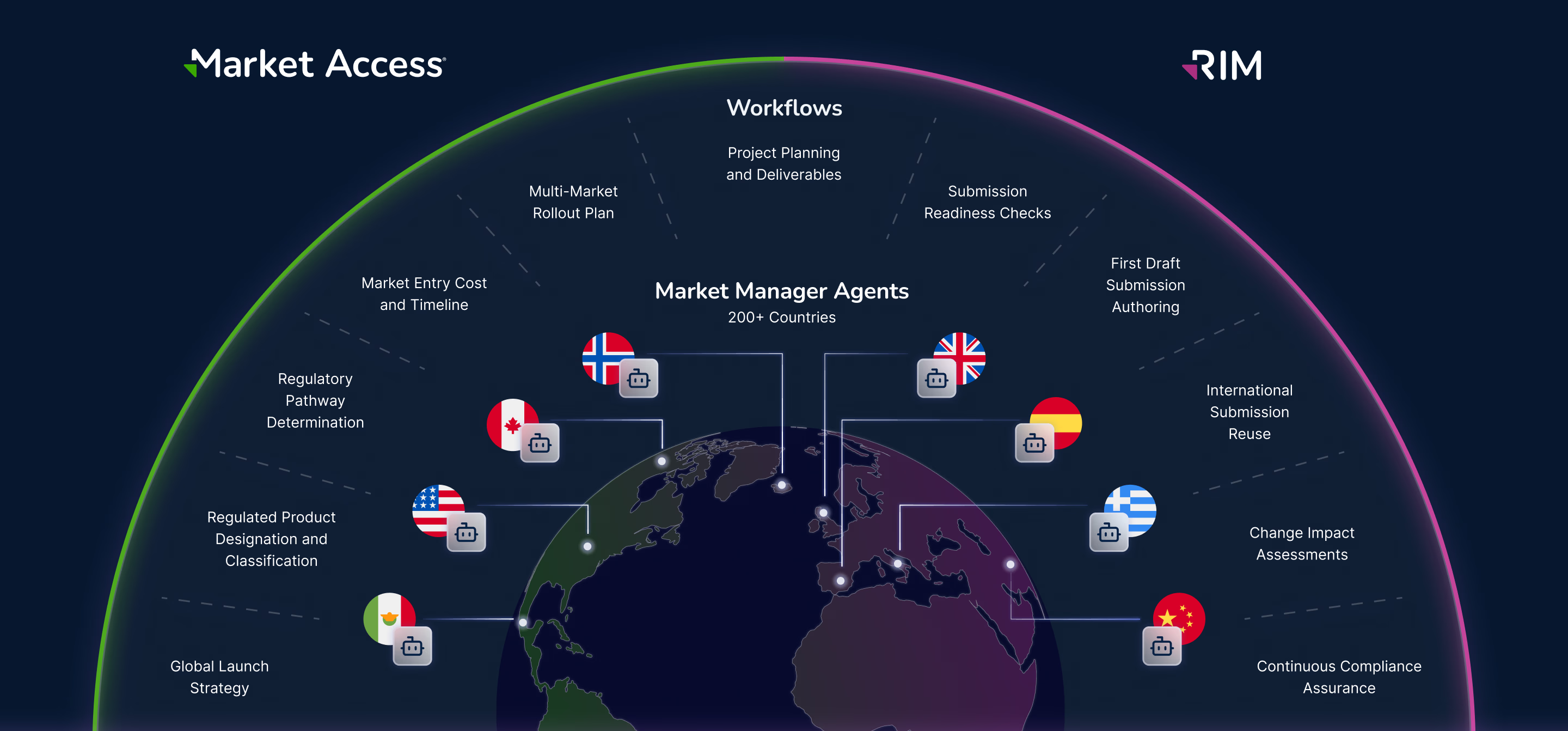
Pase two has really been in and is all about the Intelligence. And so if you think about everything we've done in the phase one of the company where it's the information management, the we're call it the data layer. Now, we're entering the phase two, we're now we can overlay intelligence and market information directly over that data layer, so you can do some really fun and interesting and innovative things with that data. And so from an AI standpoint, we actually have some things coming down the pipeline at the end of this year, early next year, that's really going to help one with data ingestion in our system.
You know, we have companies that have 300,000 products and 249 countries globally and that's just one company, right? And so there are some really interesting things we can do with data ingestion and data maintenance from our standpoint. But also there's some really interesting things we're gonna do with market intelligence notifications of, you know, regulatory changes in the market as well as some things that are coming through with submissions as well. And, and we have a really nice road map played out that in the next six to 12 months that it'll be, it's gonna be really cool to see some of those things come to fruition here.
Steve Gens: Yeah. There's there's a lot. I just took a lot of notes on that on this and just a few comments I think, you know, for our listeners too, just another layer of complexity between, the med tech and pharmaceutical is, besides the things you've mentioned, I've mentioned, you know, you're dealing with a class one, two or three, you know, device. So like the one client with, you know, all those products. It's kind of reminds me of the consumer side and JNJ, it's like you have Tylenol as a product but you have so many variations then different names of it in so many different countries, mind explodes just trying to manage the label.
You know on that, I think the other thing on the probably where you guys are more ahead on the medtech side is there's this nirvana of embedded reg intel, you know, where, you know, the reg intel actually directs the workflow you know, as opposed to, the user based on whatever regulatory activity you're working on. If you're doing a renewal in Thailand, for example, it has the reg intel and it knows what to do so.
The same thing too, some people are scared of AI is going to replace, you know, my job, but I think you know, more and more people realize it's a virtual assistant or a writing assistant where the AI might do the first version, one of a document, you know, the boring stuff. And then the expert medical writer would actually take it, you know, with their scientific knowledge.
And the last thing I wanted to comment to because we just finished up our very large study, you know, with AI, it's only as good as the data we've proved out. And I don't know how much of an issue. It is just like having the highest level of data quality and regulatory, but, you know, a lot of folks on the biopharmaceutical side, it's like well, you know, should we enter it centrally, decentralize, hybrid at that time? How the data is entered into data quality where that is not linked. We've proved it out that having those really good data quality practices, the data governance, have that in place and that's a direct correlation. We call those the data assets, you know. And then there's a shiny activity. If you have the right skills and the right KPI, you put those four together. And that's where the magic happens, right?
So, the last question, and actually from founder to founder, you had the sparkle in your eye when you thought about this and you actually pulled the trigger. So instead of, you know, kind of having the CEO voice, but from the founder's voice, what excites you most about Rimsys in the coming years. So, where is the company going?
James Gianoutsos: It's such a loaded question because I feel like there's so many amazing things to do. I mean, we're still at the beginning of this whole thing. And my mind has been going since, you know, 10 years ago when I first arrived this, you know, to 2017 when I first started putting… pen to paper.
And, you know, having all these tools and things that I wish I had when I was in industry would have been absolutely amazing not just from a jobs perspective standpoint, but from the company perspective standpoint because the things that regulatory does has a direct impact on the revenue as well as getting those products to market for the patients need the most and maintain those products on the market for the patients that need in the most. And so, there's a high degree of vested interest to get those products and keep those products on the market as a regulatory professional, honestly just as a human being.
And so, the things that I'm excited for are the new Rimsys Intel that we're gonna be continuing to advance here in the next six to nine months. And there's gonna be some, really exciting things, that I think there's some new adjacent product regulatory life cycle items that we can get into. So, there's always the premarket, on-market, and post-market. And we really haven't even touched post-market yet. We've really been concentrating on the on-market and premarket aspects of things and especially getting UDI right. Because at the end of the day, those udi attributes are needed for a lot of the post-market activities that are on gonna be a regulatory requirement or already a regulatory requirement.
But then two, from a reporting standpoint, you're gonna need to maintain those products in the market. And so, there's this continuum of information management that we're gonna be continuing to do and gather, and address, and then, the layering on top of that Rimsys, Intel is absolutely gonna be a game changer because nobody really does RIM like Rimsys, and, you know, we've had the luxury of building this from the ground up specifically dedicated to the medtech industry. And that has so many more advantages than trying to, reposition or retransform an existing system to medtech because it just, it doesn't translate. And so, I'm really excited, for some of those aspects.
Steve Gens: Yes, indeed. You know, a very exciting, and also just an amazing journey in just seven years. So, and it seems like it's a very bright future, you know, for you. So, so thanks again for your time, you know, some very Rich and insightful discussions, you know, and it's great with our listeners and some of them are many of them are biopharmaceutical, you know, learning a little bit more about the med tech side.
But in the lens and why I thought this was so important and we kind of touched on it just the growing a portfolio of combination products - It's just really merging our latest data. Had 60 percent of the companies with their product portfolios have combination products. So that's something that's growing. So certainly listeners, if you're on the biopharmaceutical side, you know, maybe you have combo products or a device division, you know, definitely give them a look. Yeah. So as we kind of, you know, close up, some of our listeners might want to get a hold of you. So what's, the best way to contact you? I don't know if it's through the website or LinkedIn or, what would you suggest?
James Gianoutsos: Yeah, I would say definitely get our website: www.rimsys.io. You can schedule a demo and you can actually just put a Linkedin request to me directly. I love talking shop. I love talking specifically around regulatory complexities and some of the issues that you're experiencing firsthand because at the end of the day, those help continue to expand our system capabilities and serve, the medtech market. You know, one of the things that I'm really proud of with Rimsys is, you know, we already have 40 percent of the top 10 medical device manufacturers globally and we're expanding more. And this is a really exciting time for the industry as well, as well as, for Rimsys as we enter into this new phase of growth.
Steve Gens: Excellent. And, you know, indeed. And I think, you shared, you know, the other day, well name of another very impressive logo thatat you're gonna be starting to work with there. So before I say goodbye to the listeners, you know, we're both fouders and have that in common. But I would be remiss here. Maybe this is more for us listeners that you're based in Pittsburgh, Pennsylvania. I grew up in central Pennsylvania. So it's the black and gold. I know we talk about the Pittsburgh steelers, the, you know, NFL football seasons about ready to kick off. So hopefully the black and gold, the Pittsburgh steelers are gonna do well. I know we another thing that we have in common. Yeah.
So with that said with our listeners, if there's any questions you have for the Gens team use our contact page off of our website or similarly just reach out, I'm on Linkedin quite a bit and please enjoy our other podcasts. We actually just reorganized our whole podcast web page to have a section for this executive series, our world class RIM research, and then a third as we have different subject matter experts, really talking in detail about some of the key issues that industry works on today. So again, James, thanks a lot for your time and maybe in another six or nine months, we'll have you come back and see where yourself and Rimsys are at.
James Gianoutsos: Sounds great. Thank you.
_thumbnail.avif)

GET IN TOUCH