Blogs

RIM

Tackling regulatory continuity: How regulatory affairs teams can use technology to reduce the impact of employee turnover

By

Michael Peach

August 11, 2021

4 min read

Regulatory affairs is without a doubt a challenging function for all life sciences companies. In a recent survey of industry executives, 72% of them reported that regulatory affairs is one of their top 3 challenges. The pain is even more acute in the medical technology space. In the past few years medical device and in vitro diagnostic companies have had to contend with a host of new, more complex regulations for the European market (the new EU MDR/IVDR regime), as well as nascent medical device regulations in new markets around the world.

A significant additional challenge that medtech companies have to manage is that of continuity. Perhaps due to the challenges of the job, turnover among regulatory affairs (RA) professionals is surprisingly high. According to data from Zippia, RA professionals at all levels average less than 3 years in their jobs. This is echoed by the RAPS Global Compensation and Scope of Practice Report which showed that 63% of RA professionals have more than 7 years of regulatory experience, but 60% have been in their current jobs 3 years or less.

The limitations of outsourcing

One of the most common ways that medtech companies attempt to address continuity challenges is by employing external consultants. Consulting firms provide needed expertise, and especially bandwidth to resource-constrained RA teams. A recent survey by Grand View Research found that large medtech companies regularly outsource 50% or more of their regulatory activities.

Consultants are undoubtedly helpful, but the general approach to consulting engagements makes them less than ideal for a broad set of regulatory activities. Consulting engagements are inherently project-based. They generally have a specific scope, and a set of associated deliverables. However, medtech regulatory affairs is inherently product-based. Activities revolve around the product’s lifecycle—from market introduction to maintenance to withdrawal. A consulting firm may help to complete market applications for a new device in Latvia, Japan, and Brazil, but the company still needs to maintain a full post market surveillance regime, track standards in associated essential principles tables, and keep UDI information up to date as packaging permutations change.

At some point there’s a transition from the consultants back to the internal RA team, and the same continuity problem re-asserts itself. How to capture and disseminate the information, applications, and country certificates associated with a consulting project so that the internal team can move forward while maintaining compliance and market clearance?

"Poor-fit" tooling creates information silos

The lack of technology solutions designed specifically for medtech regulatory affairs is another driver of continuity issues. Regulatory activities necessitate the organization and management of large amounts of information. Detailed product specifications, performance and safety data, regulatory requirements, and relevant standards are just a few of the key pieces of information associated with each individual product and countries in which it’s sold. This is why RA professionals spend a huge amount of their time (up to 50%) simply looking for information.

Typically organizations manage regulatory information using spreadsheets or other general purpose tools. These tools, used to try and help manage information continuity, can actually create information silos. This happens for two reasons. One, the information that RA teams need for their activities is often broadly dispersed across the organization. Regulatory documents may be in a document management system (or just as often on individual employees’ computers), product and quality information is stored in PLM/QMS systems, and information about countries and selling status is contained within ERP systems. Spreadsheets don’t actually integrate with these sources, they just link. As information changes or is updated, it’s incumbent on employees to make manual updates to the spreadsheet.

Which brings us to the second problem. While there have been significant improvements in collaborative editing, documents like spreadsheets aren’t designed for the level of auditing and information management that regulatory teams need. Knowing whether an individual line item showing market status to be active, or a link to testing information in the QMS systems is up to date, still becomes “tribal knowledge” known only to the individual employees that make the update. If an employee leaves the company, all of that information goes with them.

How regulatory information management systems can improve continuity

The emergence of new technologies designed specifically for regulatory affairs activities has provided some new ways that medtech companies can tackle the continuity issue. Regulatory information management (RIM) systems provide a couple key capabilities that can increase the productivity of RA team members, and ensure that their work continues uninterrupted as team members come and go.

The first advantage of a RIM system is data association and integration. Rather than simply noting information, RIM systems can actively integrate with information sources, and automatically update as information changes. All of the information can be organized around individual products—the way that feels most intuitive to RA professionals. For any given product, an RA team member can quickly find country selling status, registrations, certificates, and expiration dates.

RIM systems can also eliminate a lot of the manual administrative work associated with regulatory activities. They can help streamline registrations with digitized authoring and publishing of regulatory submissions, and the creation and maintenance of digital essential principles tables. These capabilities are wrapped in a full set of project management tools, allowing teams to create workflows, approvals, timelines, etc. that match their internal processes and organizational goals. Individual records can be automatically updated such as the auto-population of UDI data when product details change, or bulk updates of essential principles tables when a standard is updated. These capabilities increase bandwidth across the RA team, and ensure that even new members can easily operate in accordance with the company’s processes.

RIM systems function as a “single source of truth” for RA teams. Because they work with all regulatory activities, they not only store information, but cross-link it in ways that make it instantly usable. RA team members can quickly pull regulatory information about products, product families, countries, regions, individual projects, eliminating the time spent searching for information. With enterprise integration capabilities, information can be pulled and shared with PLM, QMS, and ERP systems. This ensures that information is automatically updated, and key dependencies on regulatory activities are automatically linked. For example, clearance to enter a new market could automatically trigger a change in selling status in the ERP system. Having an organized, central source of regulatory data prevents information silos from forming, and ensures that nothing is lost when RA team members move on to other roles.

Finding the right RIM solution

Medtech regulatory complexity isn’t likely to abate any time soon, but there are steps that companies can take to better manage RA team bandwidth and continuity. Traditional approaches like outsourcing, or general productivity/information tools like spreadsheets are helpful, but they have limitations that can exacerbate continuity challenges. Modernizing the regulatory affairs toolset can be a good starting point. RIM systems with the right capabilities have the potential to increase RA team productivity, and eliminate information silos.

Key RIM features include support for a broad set of regulatory activities. Some tools focus on one aspect of RA like product registrations. As a result, they’re unlikely to effectively centralize and organize a broad set of regulatory information. While helpful from a productivity perspective, they can still lead to information silos for activities that aren’t digitized within the tool. Other RIM systems are primarily designed for the pharmaceutical industry. While they appear similar, regulations, and processes for medical technologies are different across the board. Tools that aren’t designed for medtech won’t feel as intuitive for employees, and likely won’t do as good a job at automating regulatory activities.

Rimsys provides a full-featured RIM system that is designed specifically for medtech companies, and supports a full range of regulatory activities. To see if the Rimsys Platform can improve your RA continuity, request a custom demo today.

Similar posts

How Smith & Nephew Repositioned Regulatory as a Strategic Commercial Partner

MedTech

RIM

How Smith & Nephew Repositioned Regulatory as a Strategic Commercial Partner

By

Caroline La

May 28, 2026

4 min read

Smith & Nephew is a global medical device manufacturerwith a broad portfolio spanning orthopedics, sports medicine, and woundmanagement, sold and registered across markets worldwide. Before Rimsys,regulatory data was scattered across spreadsheets, shared drives, anddisconnected systems.

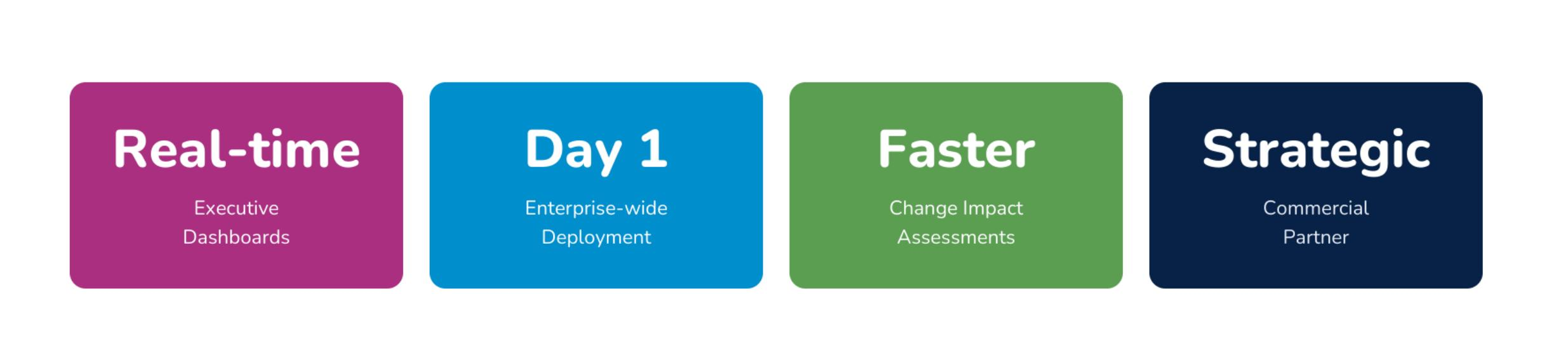
When Smith & Nephew selected Rimsys, they deployed itenterprise-wide from day one. Executive reporting moved from manual fire drillsto real-time dashboards. Change impact assessments became faster and moreconsistent. The regulatory team made the shift from reactive compliancefunction to strategic partner to the business.

The Challenge

Regulatory data at Smith & Nephew lived in multiplespreadsheets, shared drives, SharePoint sites, emails, and disconnectedsystems. Without a centralized record, the team could not reliably trackregistration timelines, measure on-time submissions, assess change impacts, orunderstand the downstream impact of product changes across markets. Preparingexecutive reporting meant manually assembling data from multiple sources, aprocess that consumed time and introduced risk each time.

The Solution

Smith & Nephew selected Rimsys for its configurable, notcustomized, platform: an intuitive user interface, centralized submissionmanagement, robust metrics, change assessment capabilities, and UDI supportwith machine-to-machine transmission. Rimsys’ interconnected modulearchitecture linked products, registrations, projects, change assessments, andUDI in a centralized location.

Rather than piloting in one business unit, Smith &Nephew deployed Rimsys across the entire regulatory organization from day one.The decision was deliberate: a partial deployment would have preserved thefragmentation. Enterprise-wide adoption established consistent metrics,standardized processes, and a single source of truth from the start.

The Results

Executive and board reporting, previously built from manualdata pulls, now flows directly from Rimsys in real time. What had been adisruptive, recurring effort is now a routine view. Leadership has thevisibility to make faster, more confident decisions, and the regulatory team isno longer pulled into reporting fire drills.

Change management has also been transformed. Direct linkagebetween products, registrations, and projects means impact assessments arefaster and less dependent on individual knowledge. UDI operations havesimilarly improved: machine-to-machine transmission has reduced manual uploadsand centralized DI record visibility supports global UDI requirements.

The most significant shift is strategic. With centralizedregulatory intelligence and real-time data, Smith & Nephew’s regulatoryteam now actively supports commercial planning: informing budget cycles,guiding renewal and launch sequencing, and advising on regulatory pathways toaccelerate market entry. Regulatory is no longer a downstream compliancefunction. It is a business partner.

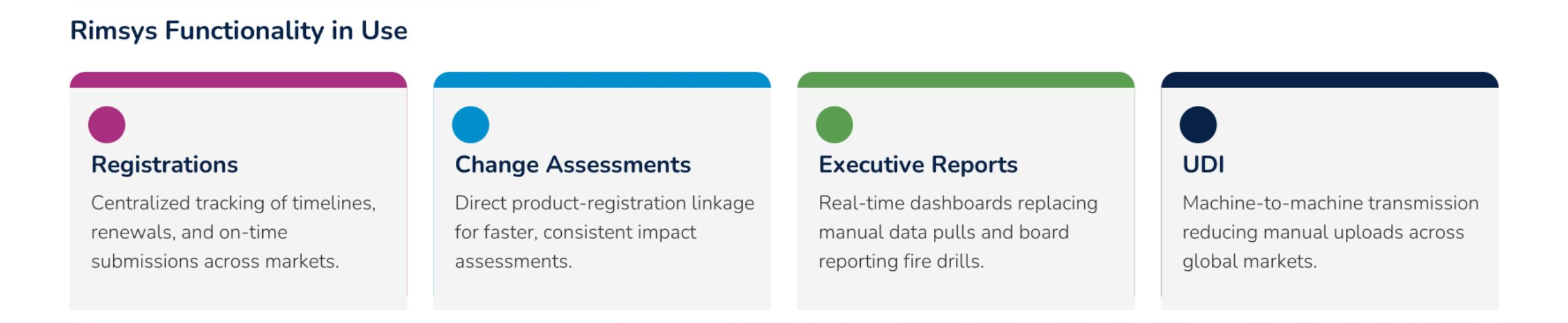
Smith & Nephew now runs four modules across its RIM operation:

  • Registrations— Centralized license tracking across 250 countries and 30+ business units
  • Change Assessments— Direct product-registration linkage for faster, consistent impact assessments
  • Executive Reports— Real-time dashboards replacing manual data pulls and board reporting fire drills
  • UDI— Machine-to-machine transmission reducing manual uploads across global markets

Take this to your team

If you’re evaluating how to modernize RIM operations at scale, the Smith & Nephew case study is a practical reference to share internally. It covers the full implementation story, module breakdown, and results data in a format built for stakeholder conversations.

Download the Case Study

MedTech

RIM

How Philips Scaled Active Product Registrations More Than 20x

By

Caroline La

May 21, 2026

4 min read

Philips Healthcare operates one of the largest regulatory portfolios in global MedTech: products registered across 250 countries, with a footprint that grows with every acquisition. Before Rimsys, that complexity was managed through email and spreadsheets. Submission packages moved through inboxes with no audit trail, no performance data, and no reliable view of where products were authorized to ship.

Philips selected Rimsys in 2022 as the enterprise RIM platform to bring regulatory order to that complexity. Since go-live, active product registrations have scaled more than 20x, user adoption has doubled in the last six months, and the regulatory affairs function now operates from a single source of truth spanning the entire enterprise.

The Challenge

Without structured data, Philips could not measure regulatory performance, track license expiration across the portfolio, or identify where submission work was stalling. Every acquisition made it worse: incoming business units arrived with their own workflows and systems, absorbing more fragmentation rather than resolving it.

The Solution

Philips evaluated multiple platforms against requirements built with both market-facing and business regulatory affairs teams. Rimsys won on two dimensions: an interface that made complex product and registration data immediately visible, and more enterprise-ready features than competing platforms at the right price point.

Philips went live with Rimsys Registrations and Submissions modules in July 2022. The team deployed platform experts for train-the-trainer sessions and launched regular drop-in sessions where users could ask questions and surface issues. Standing up a dedicated Regulatory Operations team focused exclusively on rest-of-world registration accelerated adoption further.

When an early business unit pushed back on workflow efficiency, Philips and Rimsys worked through it together. A hands-on process walkthrough identified exactly what needed to change, a resolution plan was shared, and that transparency and collaboration became the foundation for sustained user buy-in across the enterprise.

The Results

Since go-live, Philips has scaled active product registrations more than 20x, with further growth already underway. What started as a single deployment now spans 30+ business units across 250 countries, with Rimsys serving as the single source of truth for regulatory data across the enterprise, including businesses acquired since implementation.

For the first time, Philips can measure its own regulatory performance. KPIs flow directly from the platform, giving leadership real-time visibility into registration health. When anomalies surface, they drive data correction and user training, closing gaps that previously went undetected until they affected revenue.

Now with Rimsys AI-assisted Submissions and Regulatory Intelligence now in use, Philips expects to accelerate further: reducing administrative burden so skilled regulatory professionals can focus on strategy.

Philips now runs four modules across its RIM operation:

  • Registrations— Centralized license tracking across 250 countries and 30+ business units
  • Submissions— AI-assisted submission workflows replacing email-based package management
  • Intelligence— Real-time KPI dashboards giving leadership visibility into registration health
  • Standards— Essential Principles and standards tracking aligned to global market requirements

Take this to your team

If you’re evaluating how to modernize RIM operations at scale, the Philips Healthcare case study is a practical reference to share internally. It covers the full implementation story, module breakdown, and results data in a format built for stakeholder conversations.

Download the Case Study

AI

RIM

UDI

EUDAMED

MedTech

What RAPS Euro Convergence 2026 Told Us About the Future of MedTech Regulation

By

Caroline La

May 12, 2026

4 min read

Last week, the MedTech regulatory community gathered in Lisbon for RAPS Euro Convergence 2026: nearly 100 sessions, hundreds of professionals, and one overriding theme: transformation.The European regulatory landscape is shifting faster than it has in two decades, and the pressure is on every RA team to keep pace.

We were there. And here is what we took away.

The Dominant Signal: Change Is Accelerating

For MedTech manufacturers, the immediate reality is demanding. MDR 2.0 is advancing. The EU AI Act is creating new compliance obligations for software-enabled devices. EUDAMED continues to mature. And teams are being asked to absorb all of this while still meeting existing registration and renewal deadlines.

The practical implication is clear: RA functions that rely on manual tracking, disconnected spreadsheets, and tribal knowledge are being outrun by the pace of change. Across the industry, teams are moving from talking about AI to actively experimenting with it, using it to handle the volume and complexity that manual processes simply cannot absorb. The teams emerging as strategic forces are the ones who have connected, real-time regulatory infrastructure and are putting AI to work within it.

AI Is No Longer Optional Thinking

The conversation at Euro Convergence made one thing clear: AI has moved from future-state to present-tense. Regulatory professionals were encouraged to embrace AI while maintainingaccountability for the outcome and challenging the algorithms.

" Our role is to make sure that the AI does the right interpretations appropriate to our products, to our business."

— João Martins, Director of Regulatory Affairs at Abbott at RAPS Euro Convergence 2026 Opening Plenary

That framing resonates deeply with how we have built AI into Rimsys. The goal was never to replace regulatory judgment; it is to amplify it. Rimsys AI is domain-specific, built on the regulatory data structures and logic that reflect real-world requirements, country-specific nuances, and product context. It proposes, analyzes, and alerts. Your team reviews, approves, and decides.

For teams that are ready to accelerate, Rimsys AI accelerates regulatory intelligence monitoring and submission authoring, removing the repetitive, detail-heavy work so skilled professionals can focus on strategy, market expansion, and the higher-order decisions that increasingly complex regulations demand.

"As future regulators, we will need to be scientifically strong, comfortable with complexity, open to innovation, and also be able to work in increasingly complex environments."

— Rui Santos Ivo, President of Portugal's National Authority of Medicines and Health Products (INFARMED) and chair of the EMA management board, RAPS Euro Convergence 2026 Opening Plenary

MDR 2.0: Reform With Guardrails

A panel of experts representing regulators, industry, and notified bodies gave their views on the proposed revision of the EU Medical Device Regulation at the conference. While their sentiments were largely supportive, notified body representatives urged the European Commission to maintain proactive surveillance of devices to protect patients.

The discussion acknowledged the complexity of balancing reform with patient safety. Simplification and innovation go hand in hand, though if it is overly complicated or overly simplified, it becomes difficult to innovate. Structured dialogues in MDR/IVDR will provide transparency and predictability for manufacturers, especially in early product development.

Regulatory Workflows Cannot Be an Afterthought

A recurring observation across sessions was that MDR 2.0, EUDAMED, and the EU AI Act are only as effective as the operational workflows behind them. Structured dialogues, risk-proportionate pathways, and submissions all require teams to move quickly with accurate, up-to-date product data. That is simply not possible when that data lives across email threads, spreadsheets, and disconnected systems.

The workflows that came up most in Lisbon (change control, renewals, new product introductions, and registration management) are exactly the areas where manual processes create the most risk. A missed renewal. A design change that triggers 40 country-level impact assessments with no system to coordinate them. A registration record that no one has updated since the last audit.

Rimsys keeps these workflows connected and proactive. Renewal expiration reminders fire before deadlines become a risk. Change control impact surveys are configurable to your SOPs, so teams can assign tasks and coordinate work across regions without relying on someone to manually track progress. New product introductions move faster because previous submission content can be reused across markets. Target market data, registration history, and approval status are already centralized, so teams are building on existing work rather than starting from scratcheach time.

The result is regulatory operations that reduce time to market by weeks to months, not add to it. Access information in seconds rather than hours. Regulatory release authorization in minutes rather than weeks. More than 90% reduction in regional regulatory reporting time. These are not projections. They are outcomes reported by Rimsys customers operating in exactly the kind of complex, multi-market environments that dominated the conversation in Lisbon.

The Regulatory Professional Is Evolving

Perhaps the most striking thread across sessions was the evolution of the RA function itself. Regulatory work was once seen mainly in terms of compliance procedures and submissions. Today, the profession is much broader than that.

This evolution is exactly the transition Rimsys is designed to support. When regulatory data is centralized, connected, and visible in real time, RA teams stop spending their days chasing down registration status and start contributing to commercial strategy: market expansion decisions, launch sequencing, change control planning, and executive-level risk communication.

The heart of regulatory operations is not a filing cabinet. It is a living, connected system that elevates the entire function.

What It All Points To

RAPS Euro Convergence 2026 made one thing clear: the organizations that will thrive are those who have invested in regulatory infrastructure that can absorb change without breaking. Rimsys is the platform built for exactly this moment: enterprise-grade, intuitive enough for global teams to actually use, and trusted by 6 of the top 12 global MedTech manufacturers worldwide.

Book a conversation with our team

I agree to the privacy policy including to Rimsys using my contact details to contact me for marketing purposes.
Thank you! Your submission has been received!
Oops! Something went wrong while submitting the form.
Hand holding smartphone showing email app with 12 unread messages notification.