Rimsys Announces Rimsys AI. Smarter, Faster, and Built for Medtech!

Blogs

MedTech

The ultimate guide to the EU MDR/IVDR UDI

By

Bethaney Lentz

June 22, 2021

4 min read

This article is an excerpt from The ultimate guide to the EU MDR/IVDR UDI ebook.

Table of contents

Overview

The EU Medical Device Regulation (2017/745) (“MDR”) and EU In Vitro Diagnosis Regulation (2017/746) (“IVDR”) introduce two new systems for information exchange: UDI (Unique Device Identifier) for device identification and EUDAMED (European Databank on Medical Devices) to centralize and disseminate information. UDI is a specific code assigned to all devices and higher levels of packaging. This will allow for devices being sold in the European market to be identified and traced through a globally harmonized approach. EUDAMED is the IT system developed by the European Commission to replace the EUDAMED2 database previously in place under the Medical Device Directives (MDD). EUDAMED is a multi-functional system that will be used to coordinate device registration, provide information about devices to industry professionals and the public, and highlight necessary safety details.

UDI basics and benefits

The EU MDR and IVDR UDI system is based upon the guidance of the International Medical Device Regulators Forum (IMDRF). It’s a globally harmonized system that’s designed to increase patient safety and optimize care.

UDI system goals

Increase patient safety

  • Improve tracing of devices
  • Reduce the presence of counterfeit devices

Ensure access to accurate information

  • Unambiguous identification of devices throughout distribution and use

Improve post-market surveillance

  • Improve accessibility of adverse event reports

Enhance supply chain Management

  • Streamline supply chain process and inventory management
  • Simplify medical device documentation processes

The UDI system has four key elements

Element 1 Element 2 Element 3 Element 4
Assignment of a UDI consisting of:
- Basic UDI-DI
- UDI-DI and UDI-PI
- Packaging UDI
Placing UDI on Device or Packaging through UDI Carrier Storage of UDI information by Economic Operators UDI Database to Access Information

Element 1: Assignment of UDI (UDI Components)

The first element of the UDI system is the assignment of a UDI. The UDI is a code of alphanumeric characters that acts as the access key to information about a specific medical device on the market. The EU MDR and EU IVDR requires that a UDI be assigned to all medical devices except for custom-made or investigational devices. There are three components of a UDI:

  • Basic UDI-DI
  • UDI (consisting of UDI-DI and UDI-PI)
  • Packaging UDI (Note: This is not an official term used in the EU MDR and IVDR, but we’re using it to help explain the concept. The Packing UDI is part of the UDI itself.)

1. Basic UDI-DI

The Basic UDI-DI identifies the device group that a particular device fits into. A device group is a group of products that all share the same intended purpose, risk class, essential design, and manufacturing characteristics. A device group is generally classified by medical device manufacturers as a “Product Family” or “Product Category,” depending on the internal nomenclature used within the company. The Basic UDI-DI functions as a parent or higher-level descriptor of a device.

NOTE: There can only be one Basic UDI-DI per UDI-DI.

The Basic UDI-DI is not printed on the product itself or on the packaging of a product, but rather it must be included in the following documents and applications:

  • Certificates (Including Certificate of Free Sale)
  • EU Declarations of Conformity
  • Techical Documentation
  • Summary of Safety and Clinical Performance

2. UDI (UDI-DI and UDI-PI)

The second component is the UDI itself, which consists of two parts:

Device Identifier (DI)

Production Identifier (PI)

The UDI-DI (Device Identifier DI, also referred to as “static”) identifies specific, detailed information about a particular device. If any of the below details should change, the device will need a new UDI-DI.

  • Name or trade name of the device
  • Device version or model
  • If labelled as a single use device
  • Packaged as sterile
  • Maximum number of uses
  • Need for sterilization before use
  • Quantity of devices provided in a package
  • Critical warnings or contra-indication
  • CMR/endocrine disruptors

NOTE: There can be several UDI-DIs for one Basic UDI-DI.

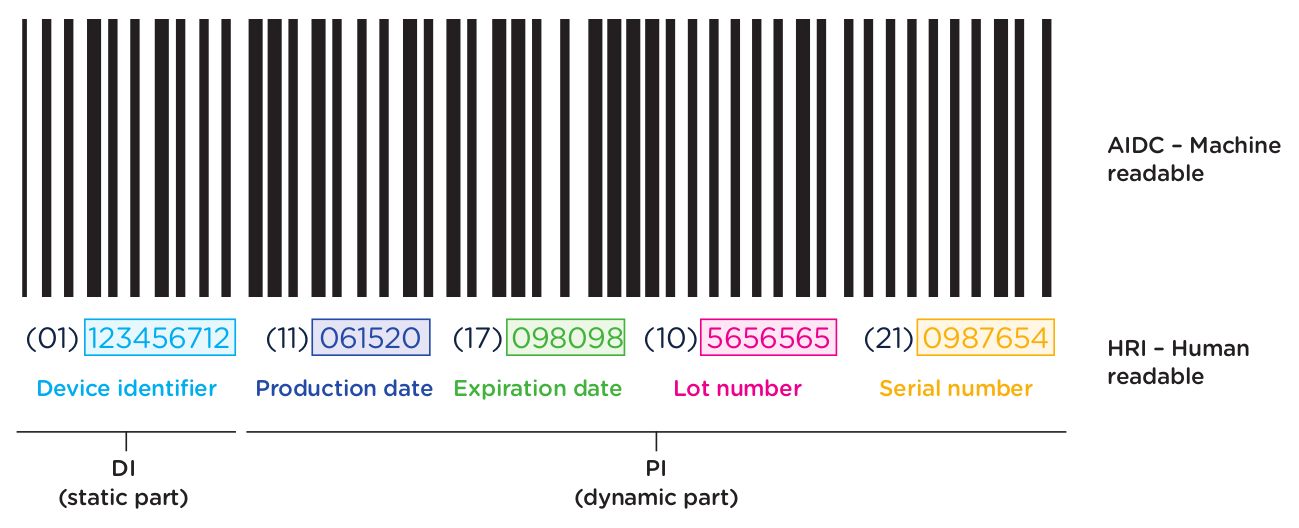
Meanwhile, the UDI-PI (Production Identifier PI, also referred to as "dynamic") contains manufacturing information (including serial number, lot/batch number, software identification, and manufacturing or expiry date or both types of dates.)

To better illustrate this concept of Basic UDI-DI and UDI (UDI-DI and UDI-PI), let’s use a syringe as an example. The Basic UDI-DI would identify the category of a syringe, for example, "Enteral (Oral) Syringe."

A 5ml Enteral (Oral) Syringe – Sterile (Color: Purple) would get a unique UDI-DI and a 10m Enteral (Oral) Syringe – Sterile (Color: Orange) would get a unique UDI-DI. Both products would be associated to the same Basic UDI-DI. In this case, the "Enteral (Oral) Syringe," which defines the category.
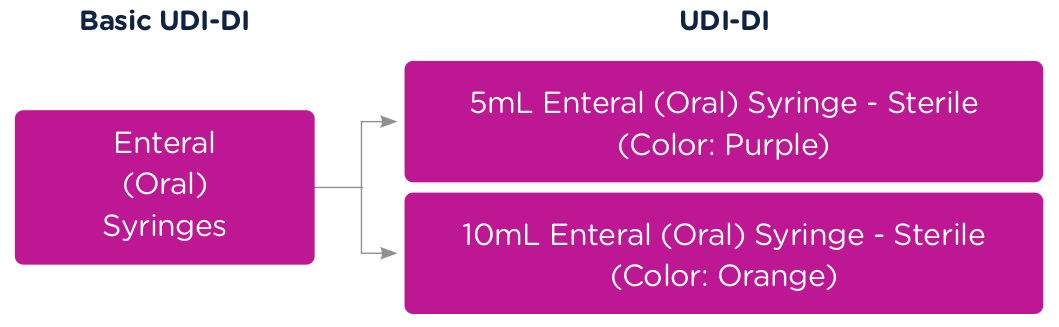
Each time that 5ml Enteral (Oral) Syringe – Sterile (Color: Purple) is manufactured at the same revision, it will get a new UDI-PI per lot. See the graphic below.

Each product is identical and therefore has the same UDI-DI. However, the UDI-PI changes to reflect the manufacturing date, lot number, expiry date, and serial number, as applicable.

The UDI will contain all device-specific information and have the same functions as the comparable database (GUDID) of the United States FDA. The main difference (in EUDAMED) is that the UDI data is divided into components of Basic UDI-DI, UDI, and Packaging UDI.

3. Packaging UDI

The third component of UDI is the Packaging UDI. (Note: This is not an official term used in the EU MDR and IVDR, but we’re using it to help explain the concept.)

Each level of packaging, except shipping containers, must receive its own unique UDI. Packaging UDI refers to the unique UDI assigned to higher levels of packaging instead of the device itself.

In the event of significant space constraints on the unit of use packaging, the UDI Carrier may be placed on the next higher packaging level.

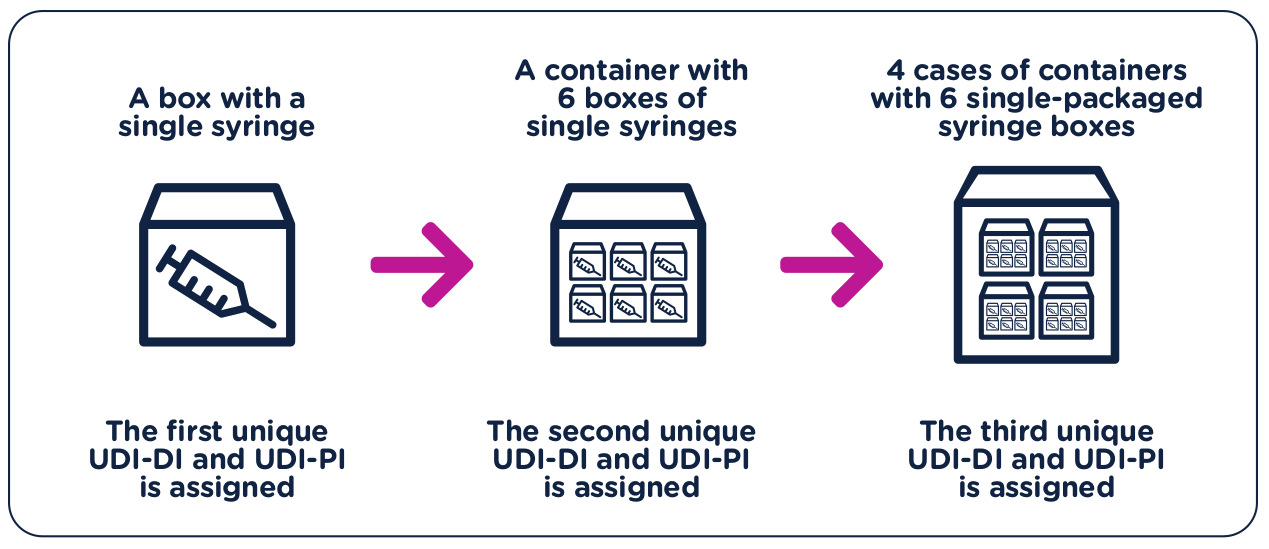
Returning to our earlier example of syringes, if a manufacturer first packages a single sellable syringe into an individual box, this package would receive its own UDI-DI and UDI-PI.

If then the manufacturer packages those individual boxes into containers of six (6), those containers would receive their own UDI-DI and UDI-PI.

And finally, if the manufacturer packages those six (6) containers into cases of four (4), those cases would receive their own UDI-DI and UDI-PI.

Each of those levels of packaging must be assigned its own UDI-DI and UDI-PI. The initial syringe did not change, but the way it is packaged did, therefore, requiring its own UDI-DI and UDI-PI.
Element 2: Placing UDI on the device and/or packaging

The second element to the UDI system is the placing of the UDI on the device or on its packaging through what is referred to as a “UDI Carrier.” The UDI Carrier is the part of the label that contains the UDI information that is applied directly to the device or included on the device packaging. The UDI Carrier should have both a machine-readable portion (AIDC) and a human-readable portion (HRI). (Specific details about each element of the UDI will be covered in Chapter 2.)

  • Machine-readable form – AIDC – (Automatic Identification and Data Capture) is a barcode or other machine-readable technology that can be accessed automatically by scanning the UDI information.
  • Human-readable form – HRI – (Human Readable Interpretation) is the numeric or alphanumeric code, which can be manually entered into the system for access to the UDI information.

If there are space constraints limiting the use of both the AIDC and HRI on the label, then only the AIDC is required to appear. However, on devices that are intended to be used in home-health care or other non-medical facility settings, the HRI would be required to appear.

Single-use devices may contain the UDI Carrier on its lowest level of packaging rather than on the device itself.

Reusable devices must include the UDI Carrier on the device itself, unless any type of direct marking would interfere with the safety or performance of the device, or if it is not technologically feasible to directly mark the device. If so, this should be properly documented in your design history file.

Most importantly, the UDI Carrier must be readable for the intended lifecycle of the device.

Below is an example of a GS1 AIDC and HRI barcode label.
Element 3: Storage of UDI information by Economic Operators

Storage of UDI information by "Economic Operators" is the third element of the UDI system. 2017/745 Articles 2(35), 22(1), and 22(3) define an economic operator as:

  • A manufacturer
  • An authorized representative
  • A distributor
  • An importer
  • An investigator for clinical investigations
  • A person who sterilizes systems or procedure packs

Class III, implantable device:

According to EU MDR 2017/745 Annex II, the manufacturer shall keep an updated list of all UDIs that it has assigned. Economic operators and all health institutions are required to store, preferably by electronic means, the UDI of all the devices for which they have supplied or with which they have been supplied.

For Devices Other than Class III:

Member States are encouraged, and in some cases require, health institutions to store, preferably by electronic means, the UDI of the devices with which they have been supplied. The UDI must also be included in any field safety notice for reporting serious incidents and field safety corrective actions.

The EU MDR and EU IVDR also give the European Commission authority to make additional requirements regarding the submission or maintenance of UDI information. In making those decisions, the European Commission must consider six (6) areas:

  • Confidentiality and data protection
  • Risk-based approach
  • Cost-effectiveness of the additional measures
  • The need to avoid duplications in the UDI system
  • The needs of the healthcare systems of the member states
  • Harmonization with other medical device identification systems

Element 4: The UDI Database

To continue reading this eBook including information about the EUDAMED database, UDI format requirements and issuing entities, implementation timelines, and key differences between the EU and US UDI systems, please register to download the full version

Similar posts

Company

Rimsys Launches the Regulatory Execution Engine for MedTech

By

May 5, 2026

4 min read

Spring 2026 embeds submission authoring, AI-powered regulatory monitoring, and configurable impact workflows inside a single RIM platform, the first step toward Rimsys' AI vision for global regulatory operations.


PITTSBURGH, PA, May 5, 2026 – Regulatory Information Management (RIM) software was built to store records. That foundation has served its purpose and reached its limit. Today, Rimsys announces the Spring 2026 release: a platform designed not to hold regulatory data, but to execute on it.

Submission volumes are growing. Markets are multiplying. Regulatory change is accelerating. Spring 2026 gives regulatory teams the tools to keep pace: embedded authoring, reusable submission content, configurable impact workflows, and AI-powered intelligence, all inside a single platform.

"Our vision for Rimsys is a platform that makes regulatory expertise go further, companies move faster, and products reach more markets than any team could accomplish alone. Spring 2026 is another meaningful step toward that vision. We are embedding the tools and intelligence that allow regulatory affairs professionals to operate at a different level, doing more strategic work, entering markets faster, and staying ahead of regulatory change rather than reacting to it. What we are building next makes this release the starting line." – James Gianoutsos, CEO

What Spring 2026 Delivers

A brand new website that provides in-depth information about the Rimsys offering and the benefits to MedTech manufacturers, including details on these new products:

Intelligence: AI-Powered Regulatory Monitoring

Rimsys Intelligence provides access to regulations, guidance documents, safety alerts, and legislation across more than 90 countries. AI triage and prioritization surface the updates most relevant to each customer's specific products and markets, eliminating hours of manual surveillance and putting the right information in front of the right people.

When a change requires action, teams can move directly from regulatory signal to impact assessment without a manual handoff. Intelligence represents Rimsys' first production deployment of context-aware AI operating across a customer's live regulatory data, a foundation that will expand significantly in future releases.

Advanced Submissions: A Unified Submission Execution Workflow

Advanced Submissions consolidates everything required to create, manage, and publish a regulatory submission into a single workflow inside Rimsys, eliminating the disconnected tools, manual reformatting, and version fragmentation that have defined submission work for too long. Three capabilities anchor it:

Rimsys Editor

The Rimsys Editor is the cornerstone of Advanced Submissions and the most significant capability in this release. It brings word-compatible authoring and editing natively inside Rimsys, fully compatible with Microsoft Word®, allowing regulatory teams to create, co-author, review, and publish submission content without leaving the platform for the first time.

The Editor supports real-time co-authoring, tracked changes and redlining, rich content including tables and images, document comparison, and PDF publishing with standardized headers, footers, and company branding applied automatically. AI-assisted authoring is available as a configurable option, enabling teams to summarize, refine, expand, and translate content within their workflow. Rimsys AI is human-in-the-loop by design.

Universal Submissions

Universal Submissions enables teams to build from a single universal template (an IMDRF Technical Document) with content automatically mapped into market-specific templates. One master structure, many markets, without rebuilding from scratch.

Reusable Submissions

Reusable Submissions takes a completed submission from one market and uses it as the starting point for a new one. The system automatically maps content into the target market's template, carrying applicable sections forward reducing the content creation time up to 90% and compressing the time required to enter each additional market.

Configurable Impact Surveys: Governed Change Assessment at Scale

Impact Surveys are now fully configurable. Templates can be defined for specific change event types, tied to countries or registrations, and triggered automatically from Rimsys Intelligence findings replacing ad hoc assessments with repeatable, governed workflows. This integration creates a direct line from change event to regulatory scope, with results tracked in a single audit-ready trail.

A Platform Built for What's Next

Spring 2026 establishes more than a set of new capabilities. It establishes the execution infrastructure, structured data model, and embedded AI foundation on which Rimsys' longer-term vision is being built.

That vision: a world where regulatory experts are amplified by intelligence, not constrained by information. Where the knowledge required to enter a new market, interpret a regulatory change, or scope a submission is instantly available to every member of the team. Where regulatory operations scale not by spreading experts thin, but by giving them tools that multiply their impact.

Spring is the first production step in that direction. Every submission authored inside the platform, every intelligence signal triaged by AI, and every impact assessment connected to structured regulatory data deepens the foundation. Future releases will build on it directly, expanding AI capabilities, automating more of the regulatory workflow, and ultimately enabling teams to do work that today requires external expertise to be done inside Rimsys.

Regulatory Execution as a Business Lever

Spring 2026 is built to move metrics that matter: reduced submission cycle time variance, improved approval predictability, lower marginal effort per market, and increased team capacity without proportional headcount growth. For executive leadership, earlier approvals translate directly into faster market access and accelerated revenue recognition.

Availability

Spring 2026 is now Generally Available. Existing customers on the Organizer product will retain access to their current experience.

To learn more about the Spring 2026 release and how Rimsys can accelerate your regulatory operations, visit rimsys.io or contact your Rimsys representative.

About Rimsys

Rimsys is the heart of regulatory operations for the medical device industry and the platform at the center of an AI-driven transformation in how regulated products reach global markets. A living, connected regulatory platform, Rimsys keeps regulatory intelligence, product data, approvals, and change management continuously connected, enabling organizations to expand into global markets with speed, precision, and confidence. Enterprise-ready yet intuitive to use, Rimsys is trusted by 6 of the top 12 global MedTech manufacturers to accelerate time to market and scale regulatory operations worldwide. To learn more, visit rimsys.io.

Media Contact

letschat@rimsys.io

rimsys.io

MedTech

Nonconformance reporting for medical device manufacturers

By

Wendy Levine

March 30, 2023

4 min read

Defining nonconformance

Very simply, a nonconformance occurs when a specification is not met. The FDA defines a specification in 21 CFR 820.3 as “any requirement with which a product, process, service, or other activity must conform,” and ISO 13485:2016 as a “need or expectation that is stated, generally implied, or obligatory.”

While managing nonconformance starts with fully defining specifications; it is the identification, tracking, and resolution of nonconformance that is a focus of medtech quality and regulatory teams and a requirement of both ISO 13485:2016 and the FDA’s 21 CFR Part 820 quality system regulation.  

Identifying nonconformance occurrences

As part of a compliant quality system, medical device manufacturers should implement procedures to identify and address both major and minor non-conformances. Nonconformances may be identified through processes found in multiple subsystems that are part of an overall quality management system within the organization.

The systems and subsystems in which nonconformances are identified typically include:

  • ERP
  • Regulatory information management (RIM)
  • Product lifecycle management (PLM)
  • Document management
  • Customer service / customer management  
  • Complaint handling
  • Device history records
  • Audit management
  • CAPA
  • Training/learning management  
  • Calibration/preventative maintenance
  • Development change management

Evaluating nonconformance

Once a nonconformance is identified, it should be evaluated in a timely manner, and a determination made as to the disposition of any affected products. Requirements for additional investigation and reporting should also be identified. Based on the severity of the nonconformance and its effect on the safety and efficacy of devices being manufactured or already in the market, a CAPA (corrective/preventative action) record may need to be created. In the U.S., this is defined in the quality regulation 21 CFR Part 820.100.

To disposition a nonconformance, consider the following:

  • Will the existing system detect the nonconformance if it recurs in time for remediation?
  • How likely is it that this issue will recur?
  • What is the impact of the non-conformance (i.e., could it affect patient health)?

Issues that are more severe or are more likely to recur should trigger a more immediate and comprehensive response.

Nonconformances that are escalated and handled under CAPA are based on risk and can include those that have or could have an impact on a product or process that is:

  • Not easily corrected
  • Recurring
  • Severe

In addition, nonconformances that rise to the level of a CAPA require significant resources and typically result in a full project to identify root cause(s), containment, and corrective actions, and monitoring for effectiveness.  

Nonconformances that don’t require a CAPA have simpler resolutions that include documenting actions taken to correct the issue (or justification for no action). If the issue is not recurring, there may be no other action required. For example, a nonconforming material received from a vendor may be a singular issue that was easily identified through existing inspection procedures and is not expected to recur. In this case, the material is returned to the vendor and no additional action is required.

Processes that are out of conformance are often resolved through improved documentation and/or additional user training. However, be sure that the true root cause of the nonconformance is identified as procedural nonconformances can signal additional issues.

Documenting nonconformances

An important part of nonconformance procedures is the nonconformance report (NCR) or other documentation procedures.  Nonconformances are typically documented within the subsystem in which they were identified. Some organizations will have a nonconforming system in which issues originating from all subsystems are documented. Centralized nonconformance systems allow for trending and other analysis across all subsystems, the results of which may generate CAPAs.  

The requirements for documenting a nonconformance may vary by subsystem. In general, however, nonconformance documentation records:

  • The requirement/specification that was not met.
  • The objective evidence supporting the determination.
  • The action that is being taken to address the nonconformity.

Nonconformances are a common point of focus during quality audits by regulatory bodies, including the FDA, and should follow a well-documented process. Auditors will often try to determine if the quality system is functioning effectively by looking at self-identified nonconformances and comparing them to externally reported nonconformances. This is to ensure that nonconforming products were not released, or that the appropriate actions were taken to resolve issues in the field.

The importance of nonconformance reports

Nonconformances related to distributed products of higher risk result in nonconformance reports issued to government authorities through vigilance reporting, medical device reporting, and field action/recall reports. For example, the FDA requires that a medical device report be submitted within 30 days of a serious adverse event (see 21 CFR Part 803 Subpart E). Strong reporting procedures for nonconformances of all types are important in identifying trends, addressing issues before they become critical, and as part of a complete quality management system.

A nonconformance reporting procedure is only part of a strong quality system. Read An overview of 21 CFR part 820 and ISO 13485 overview for more information on establishing quality systems for medtech companies.

Company

Why we developed Rimsys from the ground up

By

Wendy Levine

May 26, 2022

4 min read

Rimsys has had quite a year already! In early December, we closed on $16 million in Series A financing and since then we have been carefully growing the company to better serve our customers and the regulatory affairs community. We have almost doubled our employee count and redesigned the Rimsys system to deliver deeper functionality that is even easier to use. We had our first in-person employee meeting here in Pittsburgh at the end of April where we introduced our new mission statement, and we are all excited to be doing our part to improve global health!

All of these changes made us think back to the founding of Rimsys and how far we have come. So - I sat down with Rimsys Founder and CEO, James Gianoutsos, to talk about the genesis of the company and how he knew that a new type of system designed for medtech regulatory affairs professionals was needed, and needed to be built from the ground up.

Q: What was the biggest challenge you faced as a regulatory professional that led you to form Rimsys?

James: The biggest challenge I saw while working at Philips for many years was completely understanding the complexity and the nuances around everything regulatory from a product standpoint. This really came to light whenever we acquired products. Just seeing firsthand how inefficient and out of compliance these manufacturers really were, and how hard it was from an administrative standpoint just to get into compliance and then to stay compliant, was striking. 

I was working with a smaller medical device company which had acquired products from Philips. Philips provided the company with a list (a color-coded Excel spreadsheet)  of all of their products that the company had acquired along with the registration status of those products globally. After digging into the spreadsheet for several months, we found that about 50% of it was wrong, incomplete, or just completely missing. The company was trying to keep track of registration information, but the available tools were making it nearly impossible. I realized that this was the challenge, and that there really wasn’t a solution on the market that could solve that problem in an easy manner and in a medtech regulatory-focused way.

Q: There were solutions on the market that were geared more towards the pharmaceutical industry, correct?

James: Yes. So I did what every other regulatory professional did, which was to Google “regulatory software,” and I saw that there just really wasn’t anything on the market that fit our needs. The solutions on the market really were pharma-specific, even those that said they worked with medical devices. The workflows and regulatory requirements for medtech are very specific for each market, depending on the product type and risk class and so many other factors. To use a pharma system that was already on the market  just wasn’t even an option because it was like comparing apples to oranges. It is completely different from the regulatory and workflow side of things.

Q: There are existing tools used by the regulatory community, such as quality management and document management systems. Did you envision the new RIM system integrating with existing tools, replacing them, or a little of both?  

James: I never set out to replace those types of systems, no. In fact, I knew that existing system architecture and infrastructure couldn’t handle the specific medtech regulatory workflows but needed to connect to those systems. There have always been PLM (Product Lifecycle Management) systems that contain a company’s product master data, but those systems were never meant to be workflow-driven based on regulatory requirements. At the same time, they are critical for organizing and maintaining product-specific metadata. Then there are ERP systems, which are really about making sure companies have sales flags (i.e. regulatory blocks) in place, appropriate shipping codes, or selling status linked to product registration status. Regulatory professionals are concerned about answering two questions for ERP users; one, “does the product have a valid and current registration within the country or market,” and two, “if it is registered, are we selling and shipping into that market.”  Lastly, quality/document management systems house critical documentation and records needed for registrations. The problem with these systems is that there are no regulatory workflows and no way to compile technical documentation, leaving the documents and records siloed from the regulatory filings.

To do the things that a regulatory affairs professional, in a critical regulatory department, does for their company, the system really had to be built from the ground up with all of these systems in mind. It had to be product-centric. It had to integrate with all these other sources of information, because there really wasn’t a common connection point between your products, your documentation, and the records that you needed to compile and how that relates to getting products on the market. We had no way to communicate to our other systems that a product is actually available for sale in that market or that it confidently can, or more importantly cannot, ship to that market.

Q: What was the most difficult piece of functionality to implement in Rimsys?  

James: Well, at the time it kind of all seemed difficult! No, really the most difficult part was thinking thoughtfully and strategically about how data was going to be mapped and used in conjunction with other data elements, in order to make the system most helpful from a user perspective. We wanted to single-source information to enhance and streamline regulatory workflows, but then also make sure that it was as user friendly as possible. There are a lot of stakeholders that need information or have input into regulatory workflows. Quality assurance, marketing operations, R&D, engineering, sales - all of those specific stakeholders need to view information in a way that is understandable to them.

We worked hard to bring all that information, streamline complex regulatory workflows, and all of those internal and external data sources together in an understandable and user-friendly way.

Q: How important has the technology itself been in the creation of Rimsys?

James: Technology has been a huge advantage for us from day one. Our team had quality and regulatory backgrounds, so we knew what companies would expect from us. We knew we had to be 21 CFR Part 11 compliant. We knew we had to be ISO 27001 certified. We knew we had to have SOC2 Type 2 reports. We knew we had to integrate with a company’s existing IT infrastructure. We really had to build this thing from the ground up on a GxP compliant platform that we could build upon and expand, without having to go back and reinvent the wheel every time we added new functionality. 

It’s continued to pay dividends for us because it was something that we thought about from the beginning and that gave us a lot of flexibility. We already had the system and infrastructure in place that we could then expand upon a lot more quickly than we would have been able to otherwise. It’s like the difference between building a house today and trying to remodel a house that was built in the year 1900. If you break down a wall in the older house, there might be so many hidden issues behind that wall - load bearing issues, knob and tube wiring, asbestos, etc. With new modern infrastructure, it is just night and day in terms of adapting quickly with changing regulations and a fast-paced market.

Q: Was there any specific technology you can talk about that became important to the development of Rimsys?

James: Our choice of technology was driven by our desire to build a system that was user friendly and built on a modern infrastructure that felt familiar to our users. So, we took a lot of the Google framework to build an application that didn’t look like enterprise software, but looked and felt more like a consumer product that is inviting, not overwhelming. 

The other thing is that we built the system from day one to integrate because we knew we had to connect with a lot of different sources of information. We strategically built the system with API’s in mind.

Q: What is Rimsys doing differently than other software companies in the regulatory space?

James: We are creating a holistic solution, which is different from what is out there now. We know that registration management is just one key aspect of what regulatory affairs teams need. In order to create a proper regulatory system, we had to take into account all of the data and dependencies and build a system specifically for medtech regulatory teams and other key consumers of regulatory data. There has to be a single source of truth for this data, because otherwise it becomes a nightmare at the end of the day. Existing software solutions were siloed and purpose-built for other industry needs, such as eQMS, PLM and ERP. None of those systems can do what a holistic RIM platform can do. Because of the complex workflows, the regulatory needs are far too broad and interdependent, that data infrastructure is completely different, data sources are too numerous, and the systems offer limited support to bring everyone and everything together into a cohesive, streamlined, compliant and medtech-specific solution.

Another key component of what we are doing is to institutionalize regulatory knowledge and resources into Rimsys—this is at the heart of who we are and what we do. Having the only purpose-built, holistic RIM platform built by and for regulatory professionals specific for the medtech industry really couldn’t be done without internalizing that experience within our own team.

Q: What are you most proud of when it comes to Rimsys? 

James: I think there are two things that immediately come to mind. Having our Rimsys 5 platform launch is really exciting. This is the fifth iteration of our platform, and we did it by listening to our customers and iterating over and over again to get it right. We had to go back to the drawing board a couple of times, not because what we had written wasn’t working, but because our customers that were using the system every day gave us better ways to do things. Rimsys 5 is a really proud moment because this is the platform that we are taking into the future, that will let us get to the next level where we are truly empowering regulatory professionals to make critical decisions and do the job that they are meant to do. 

The ability for us to listen to our customers, take that feedback and move fast is the second thing I’d mention here. We know that this has to be a validated system, but we are able to make changes and add features in a way that is thoughtful and gets our customers what they need right away. Regulatory professionals are very particular. I know since I am one, and making sure they are comfortable using Rimsys from day 1 is critically important. Being a customer-centric company really makes our experience as a team extremely rewarding.

Q: Where is Rimsys going next?  What are you most excited about?

I think I am most excited about Rimsys being an advocate for the medtech regulatory community and helping them wherever we can. Regulatory has a seat at the table now and it is a great feeling to see that we’re able to help these companies to streamline their workflows, accelerate time to delivery for life-saving products and maintain that compliance to keep those products on the market. Regulatory affairs is a mission critical department that the medtech industry cannot underestimate. It’s empowering because while we are helping our customers, they are helping us and every single one of our other customers through the journey of regulatory uncertainty that everyone is going through right now. It feels like a real partnership between us, our customers, and the industry as a whole and I am excited to see where that will take us.

I am also really excited about where we are going with regulatory intelligence. We are just scratching the surface of this now, but you will see regulatory intelligence data built into Rimsys and providing RA professionals with tools that can really provide a competitive advantage for their company. The release of Rimsys 5 platform (“Phase 1”) provides us that platform that will take us into “Phase 2” of Rimsys, with embedded intelligence that will further empower regulatory professionals to make decisive, correct and confident decisions for their products and their company.

I agree to the privacy policy including to Rimsys using my contact details to contact me for marketing purposes.
Thank you! Your submission has been received!
Oops! Something went wrong while submitting the form.
Hand holding smartphone showing email app with 12 unread messages notification.