



The ultimate guide to the EU MDR/IVDR unique device identifier (UDI) System
This article is an excerpt from The ultimate guide to the EU MDR/IVDR UDI ebook.
Table of contents
- Overview
- UDI basics and benefits
- UDI format requirements and issuing entities
- UDI rules for specific device types
- Implementation of UDI and UDAMED in the European Union
- US vs EU UDI comparison
The EU Medical Device Regulation (2017/745) (“MDR”) and EU In Vitro Diagnosis Regulation (2017/746) (“IVDR”) introduce two new systems for information exchange: UDI (Unique Device Identifier) for device identification and EUDAMED (European Databank on Medical Devices) to centralize and disseminate information. UDI is a specific code assigned to all devices and higher levels of packaging. This will allow for devices being sold in the European market to be identified and traced through a globally harmonized approach. EUDAMED is the IT system developed by the European Commission to replace the EUDAMED2 database previously in place under the Medical Device Directives (MDD). EUDAMED is a multi-functional system that will be used to coordinate device registration, provide information about devices to industry professionals and the public, and highlight necessary safety details.
The EU MDR and IVDR UDI system is based upon the guidance of the International Medical Device Regulators Forum (IMDRF). It’s a globally harmonized system that’s designed to increase patient safety and optimize care.
UDI system goals
Increase patient safety
- Improve tracing of devices
- Reduce the presence of counterfeit devices
Ensure access to accurate information
- Unambiguous identification of devices throughout distribution and use
Improve post-market surveillance
- Improve accessibility of adverse event reports
Enhance supply chain Management
- Streamline supply chain process and inventory management
- Simplify medical device documentation processes
The UDI system has four key elements
Element 1: Assignment of UDI (UDI Components)
The first element of the UDI system is the assignment of a UDI. The UDI is a code of alphanumeric characters that acts as the access key to information about a specific medical device on the market. The EU MDR and EU IVDR requires that a UDI be assigned to all medical devices except for custom-made or investigational devices. There are three components of a UDI:
- Basic UDI-DI
- UDI (consisting of UDI-DI and UDI-PI)
- Packaging UDI (Note: This is not an official term used in the EU MDR and IVDR, but we’re using it to help explain the concept. The Packing UDI is part of the UDI itself.)
1. Basic UDI-DI
The Basic UDI-DI identifies the device group that a particular device fits into. A device group is a group of products that all share the same intended purpose, risk class, essential design, and manufacturing characteristics. A device group is generally classified by medical device manufacturers as a “Product Family” or “Product Category,” depending on the internal nomenclature used within the company. The Basic UDI-DI functions as a parent or higher-level descriptor of a device.
NOTE: There can only be one Basic UDI-DI per UDI-DI.
The Basic UDI-DI is not printed on the product itself or on the packaging of a product, but rather it must be included in the following documents and applications:
- Certificates (Including Certificate of Free Sale)
- EU Declarations of Conformity
- Techical Documentation
- Summary of Safety and Clinical Performance
2. UDI (UDI-DI and UDI-PI)
The second component is the UDI itself, which consists of two parts:
Device Identifier (DI)
Production Identifier (PI)
The UDI-DI (Device Identifier DI, also referred to as “static”) identifies specific, detailed information about a particular device. If any of the below details should change, the device will need a new UDI-DI.
- Name or trade name of the device
- Device version or model
- If labelled as a single use device
- Packaged as sterile
- Maximum number of uses
- Need for sterilization before use
- Quantity of devices provided in a package
- Critical warnings or contra-indication
- CMR/endocrine disruptors
NOTE: There can be several UDI-DIs for one Basic UDI-DI.
Meanwhile, the UDI-PI (Production Identifier PI, also referred to as "dynamic") contains manufacturing information (including serial number, lot/batch number, software identification, and manufacturing or expiry date or both types of dates.)
To better illustrate this concept of Basic UDI-DI and UDI (UDI-DI and UDI-PI), let’s use a syringe as an example. The Basic UDI-DI would identify the category of a syringe, for example, "Enteral (Oral) Syringe."
A 5ml Enteral (Oral) Syringe – Sterile (Color: Purple) would get a unique UDI-DI and a 10m Enteral (Oral) Syringe – Sterile (Color: Orange) would get a unique UDI-DI. Both products would be associated to the same Basic UDI-DI. In this case, the "Enteral (Oral) Syringe," which defines the category.
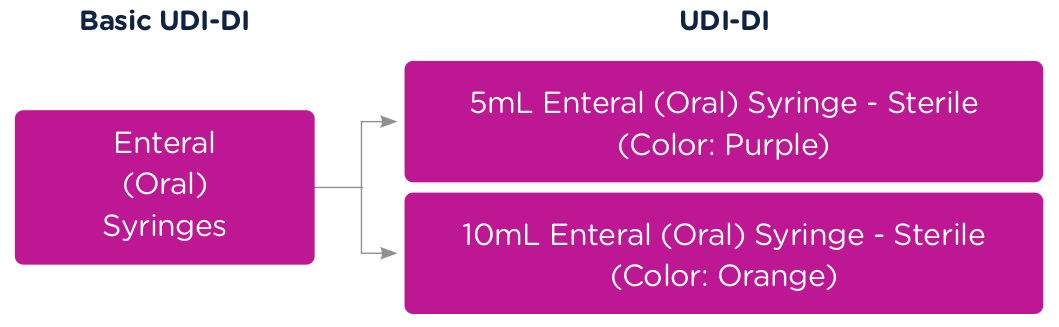
Each time that 5ml Enteral (Oral) Syringe – Sterile (Color: Purple) is manufactured at the same revision, it will get a new UDI-PI per lot. See the graphic below.

Each product is identical and therefore has the same UDI-DI. However, the UDI-PI changes to reflect the manufacturing date, lot number, expiry date, and serial number, as applicable.
The UDI will contain all device-specific information and have the same functions as the comparable database (GUDID) of the United States FDA. The main difference (in EUDAMED) is that the UDI data is divided into components of Basic UDI-DI, UDI, and Packaging UDI.
3. Packaging UDI
The third component of UDI is the Packaging UDI. (Note: This is not an official term used in the EU MDR and IVDR, but we’re using it to help explain the concept.)
Each level of packaging, except shipping containers, must receive its own unique UDI. Packaging UDI refers to the unique UDI assigned to higher levels of packaging instead of the device itself.
In the event of significant space constraints on the unit of use packaging, the UDI Carrier may be placed on the next higher packaging level.
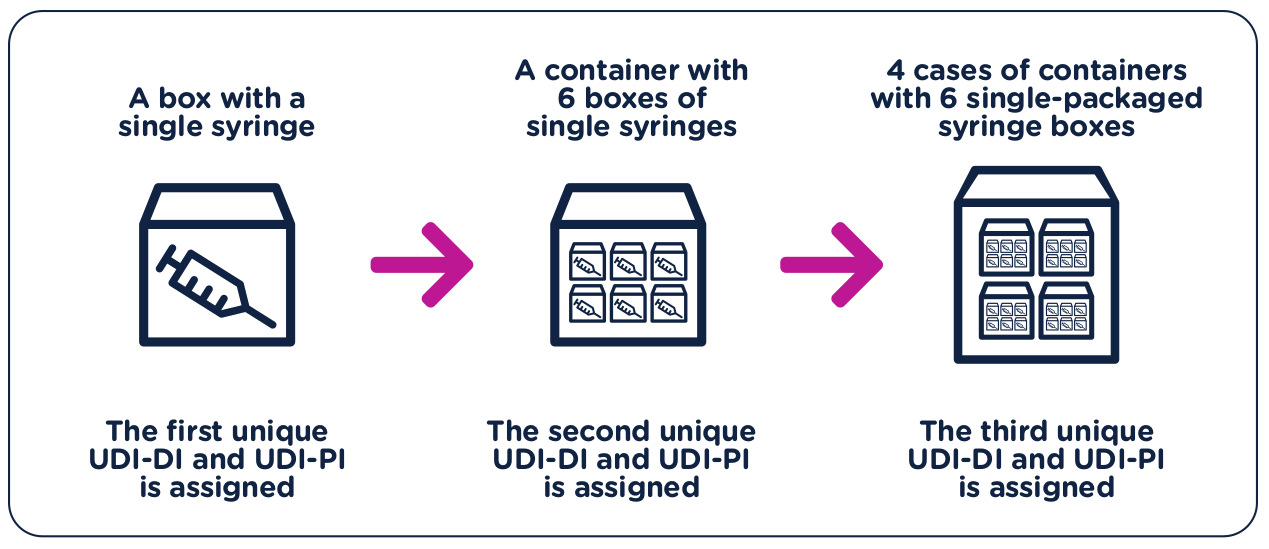
Returning to our earlier example of syringes, if a manufacturer first packages a single sellable syringe into an individual box, this package would receive its own UDI-DI and UDI-PI.
If then the manufacturer packages those individual boxes into containers of six (6), those containers would receive their own UDI-DI and UDI-PI.
And finally, if the manufacturer packages those six (6) containers into cases of four (4), those cases would receive their own UDI-DI and UDI-PI.
Each of those levels of packaging must be assigned its own UDI-DI and UDI-PI. The initial syringe did not change, but the way it is packaged did, therefore, requiring its own UDI-DI and UDI-PI.
Element 2: Placing UDI on the device and/or packaging
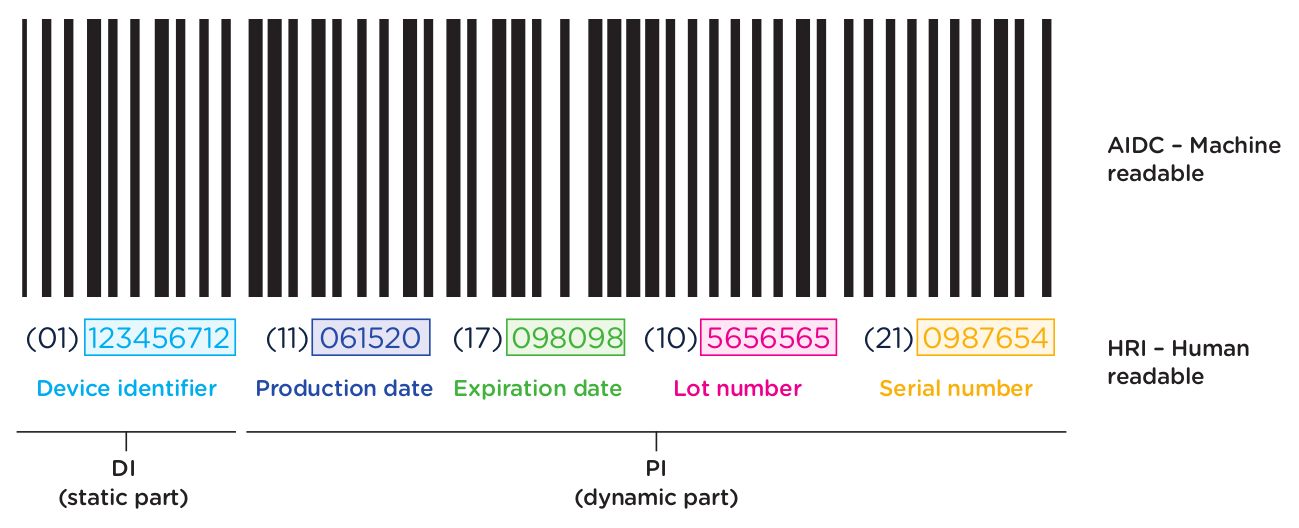
The second element to the UDI system is the placing of the UDI on the device or on its packaging through what is referred to as a “UDI Carrier.” The UDI Carrier is the part of the label that contains the UDI information that is applied directly to the device or included on the device packaging. The UDI Carrier should have both a machine-readable portion (AIDC) and a human-readable portion (HRI). (Specific details about each element of the UDI will be covered in Chapter 2.)
- Machine-readable form – AIDC – (Automatic Identification and Data Capture) is a barcode or other machine-readable technology that can be accessed automatically by scanning the UDI information.
- Human-readable form – HRI – (Human Readable Interpretation) is the numeric or alphanumeric code, which can be manually entered into the system for access to the UDI information.
If there are space constraints limiting the use of both the AIDC and HRI on the label, then only the AIDC is required to appear. However, on devices that are intended to be used in home-health care or other non-medical facility settings, the HRI would be required to appear.
Single-use devices may contain the UDI Carrier on its lowest level of packaging rather than on the device itself.
Reusable devices must include the UDI Carrier on the device itself, unless any type of direct marking would interfere with the safety or performance of the device, or if it is not technologically feasible to directly mark the device. If so, this should be properly documented in your design history file.
Most importantly, the UDI Carrier must be readable for the intended lifecycle of the device.
Below is an example of a GS1 AIDC and HRI barcode label.
Element 3: Storage of UDI information by Economic Operators
Storage of UDI information by "Economic Operators" is the third element of the UDI system. 2017/745 Articles 2(35), 22(1), and 22(3) define an economic operator as:
- A manufacturer
- An authorized representative
- A distributor
- An importer
- An investigator for clinical investigations
- A person who sterilizes systems or procedure packs
Class III, implantable device:
According to EU MDR 2017/745 Annex II, the manufacturer shall keep an updated list of all UDIs that it has assigned. Economic operators and all health institutions are required to store, preferably by electronic means, the UDI of all the devices for which they have supplied or with which they have been supplied.
For Devices Other than Class III:
Member States are encouraged, and in some cases require, health institutions to store, preferably by electronic means, the UDI of the devices with which they have been supplied. The UDI must also be included in any field safety notice for reporting serious incidents and field safety corrective actions.
The EU MDR and EU IVDR also give the European Commission authority to make additional requirements regarding the submission or maintenance of UDI information. In making those decisions, the European Commission must consider six (6) areas:
- Confidentiality and data protection
- Risk-based approach
- Cost-effectiveness of the additional measures
- The need to avoid duplications in the UDI system
- The needs of the healthcare systems of the member states
- Harmonization with other medical device identification systems
To continue reading this eBook including information about the EUDAMED database, UDI format requirements and issuing entities, implementation timelines, and key differences between the EU and US UDI systems, please register to download the full version



Is a medical device accessory a medical device?
Rimsys’ own James Gianoutsos recently contributed an article on www.meddeviceonline.com discussing FDA’s guidance document describing accessories and classification pathways.
On Dec. 20, 2017, the FDA issued Medical Device Accessories – Describing Accessories and Classification Pathways: Guidance for Industry and Food and Drug Administration Staff, which applies to the Center for Devices and Radiological Health (CDRH) and Center for Biologics Evaluation and Research (CBER) for combination products.
The guidance document offers welcomed clarity on the role of an “accessory” and its regulatory relationship to its parent device. As always, guidance documents are not legally enforceable; rather, they describe the Agency’s current thinking on a topic and should be viewed only as recommendations, unless specific regulatory or statutory requirements are cited.
The guidance explains which devices FDA generally considers “accessories” and describes the processes under Section 513(f)(6) of the Federal Food, Drug, and Cosmetic Act (FD&C Act) to allow requests for risk- and regulatory control-based classification of accessories. In other words, it specifically details what is and is not an accessory, as well as the regulatory routes to classification.
The updated guidance was derived from an August 2017 amendment to section 513(f) of the FD&C Act (FDA Reauthorization Act of 2017 (Pub. L. 115-52)) to state that “the Secretary shall … classify an accessory under [section 513] based on the risks of the accessory when used as intended and the level of regulatory controls necessary to provide a reasonable assurance of safety and effectiveness of the accessory, notwithstanding the classification of any other device with which such accessory is intended to be used.”
The amendment allows for some accessories to have a lower risk profile than that of their parent device and, therefore, may warrant being regulated in a lower class. As classifications for accessories are now risk-based, it provides manufacturers with regulatory flexibility to loosen some of the regulatory burdens on accessories that may not have the same risk profile as their parent devices.
For example, an accessory to a class III parent device may pose lower risk that could be mitigated through general controls, or a combination of general and special controls, and thus could be regulated as class I or class II. A common example of this would be a ventilation system (parent device) with a face mask (accessory).
Additionally, the guidance details the applicable definitions within Section IV: Definitions:
- Accessory — “A finished device that is intended to support, supplement, and/or augment the performance of one or more parent devices.”
- Component (21 CFR 820.3(c)) — “[A]ny raw material, substance, piece, part, software, firmware, labeling, or assembly which is intended to be included as part of the finished, packaged, and labeled device.”
- Finished Device (21 CFR 820.3(l)) — “[A]ny device or accessory to any device that is suitable for use or capable of functioning, whether or not it is packaged, labeled, or sterilized.”
- Parent Device — “A finished device whose performance is supported, supplemented, and/or augmented by one or more accessories.”
Accessory classification policy
The risks of an accessory are the risks it presents when used with the corresponding parent device as intended. To classify an accessory, FDA addresses the following two questions:
- Is the article an accessory? This can be answered by determining the intended use of the accessory. Is it intended for use with one or more parent devices, and does it support, supplement, and/or augment the performance of one or more parent devices?
- What is the risk of the accessory when used as intended with the parent device(s), and what regulatory controls are necessary to provide a reasonable assurance of its safety and effectiveness? This can be answered by providing a detailed risk assessment, outlining the potential hazards and reasonable regulatory and quality controls necessary to assure the accessory’s safety and effectiveness.
Individual accessories may be classified pursuant to the same regulation as a corresponding parent device, when appropriate, or be regulated independently.
Once an accessory has been classified, there is another consideration manufacturers need to decide: the Unique Device Identifier (UDI) rule. Not only does your parent device need to have a UDI, but any and all accessories each need to be assigned a UDI.
As 21 CFR 801 Labeling, Subpart B, Section 801.20(a) states: “(1) The label of every medical device shall bear a unique device identifier (UDI) that meets the requirements of this subpart and part 830 of this chapter,” and “(2) Every device package shall bear a UDI that meets the requirements of this subpart and part 830 of this chapter.”
Further, 21 CFR 830 UDI, Subpart A, Section 830.3 defines “finished device” and “device package” as follows:
- Finished device* means any device or accessory to any device that is suitable for use or capable of functioning.
- Device package means a package that contains a fixed quantity of a particular version or model of a device.
*Note that, although “medical device” and “finished device” are not consistent terminology used within the chapters, the terms are one and the same.
In short, any sellable finished device must bear a UDI, either on the device itself, on the device package, or both. Components to the finished device (i.e., service components and spare parts kits) are not considered accessories, and therefore are not required to bear a UDI.
What does this ultimately mean for manufacturers?
If there was any confusion as to whether a specific accessory is classified as a medical device, it has now been clarified, or at least partially clarified, depending on your specific situation. If there is still confusion among your engineering and regulatory teams, FDA recommends contacting them, via the accessory classification process outlined in the guidance, to classify the accessory appropriately. FDA will treat each accessory classification request as a Q-Submission. Requests may be for a new accessory type (new classification), an existing accessory type (reclassification), or classification of a new accessory type through the de novo process.
A gap analysis should be performed to identify a thorough and complete list of your current and future accessories to determine applicability to the guidance document. Justification also should be documented, should an accessory not apply to the guidance document. Additionally, internal procedures and the process associated with assigning UDIs may need to be updated to ensure there are no compliance gaps.

Podcast – Streamlining the MDSAP device marketing authorization and facility registration process
I had the opportunity to sit down with Jon Speer, Founder & VP of QA/RA at Greenlight Guru to record a podcast to discuss streamlining the MDSAP Marketing Authorization & Facility Registration Process.
If you are not familiar with this topic, you need to hear this.
We discuss:
- Why your regulatory team may be perceived as a bottleneck and why it is important everyone needs to be on the same page about when the product can be released.
- The connection between marketing authorization and facility registration required for various countries – United States, European Union, or elsewhere.
- The need to get organized, get better systems in place, and stay compliant when an auditor comes through your door or when you plan to sell into markets.
- Why small and large companies need to get organized now (i.e. small companies have too much information to maintain, organize, and track while large companies may have resources but suffer from miscommunication and disjointed processes.)
- The need to not be complacent and not be afraid to change systems. Rimsys was created to help regulatory professionals successfully and efficiently handle documentation.
You can hear the podcast below or at the Greenlight Guru blog.