


The beginner's guide to the FDA De Novo classification process
This article is an excerpt from The beginner's guide to the FDA De Novo classification process ebook.
Contents
- Introduction
- Chapter 1: What is an FDA De Novo request?
- Chapter 2: Contents of a De Novo request
- Chapter 3: Submitting a De Novo request
- Appendix A: Acceptance review checklist
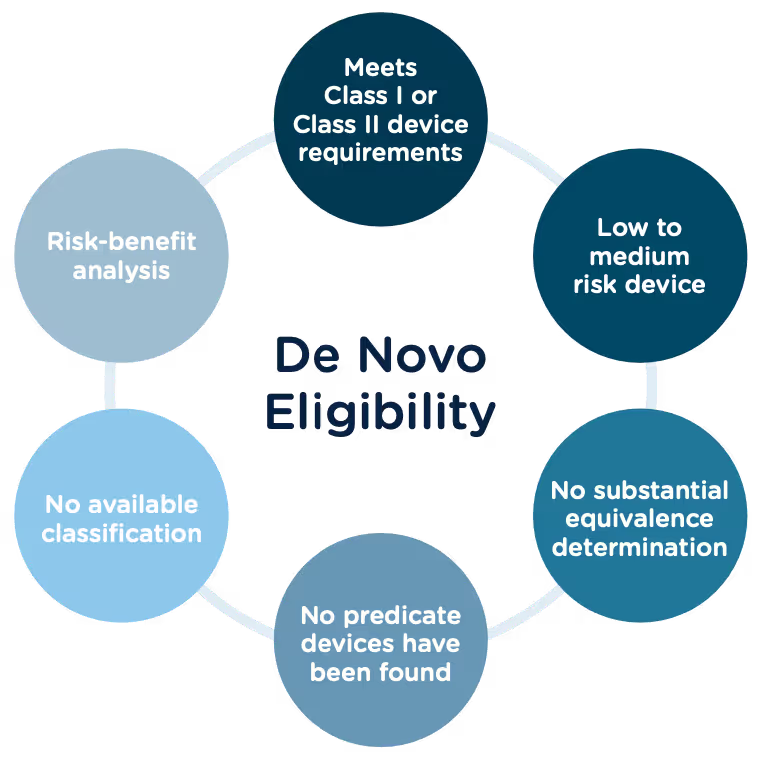
Congratulations, you have successfully developed a new medical device! Now you need to take it to market. Normally in the United States this would mean completing a 510(k) submission. However, the 510(k) relies on “substantial equivalence”—a comparison to a similar device already on the market (also called a predicate device) to assess the risk profile of the new device. What if your device is totally new, and there isn’t a similar device to compare it to? Enter the FDA De Novo process. The De Novo process provides a pathway to market for novel devices with a low to medium risk profile.
What does De Novo mean?
According to the Merriman-Webster dictionary, de novo is a Latin word meaning “as if for the first time; or anew.” Perfectly fitting that the FDA uses this term “De Novo” to describe market approval requests for new medical devices or technology where there is no comparable predicate device on the market.
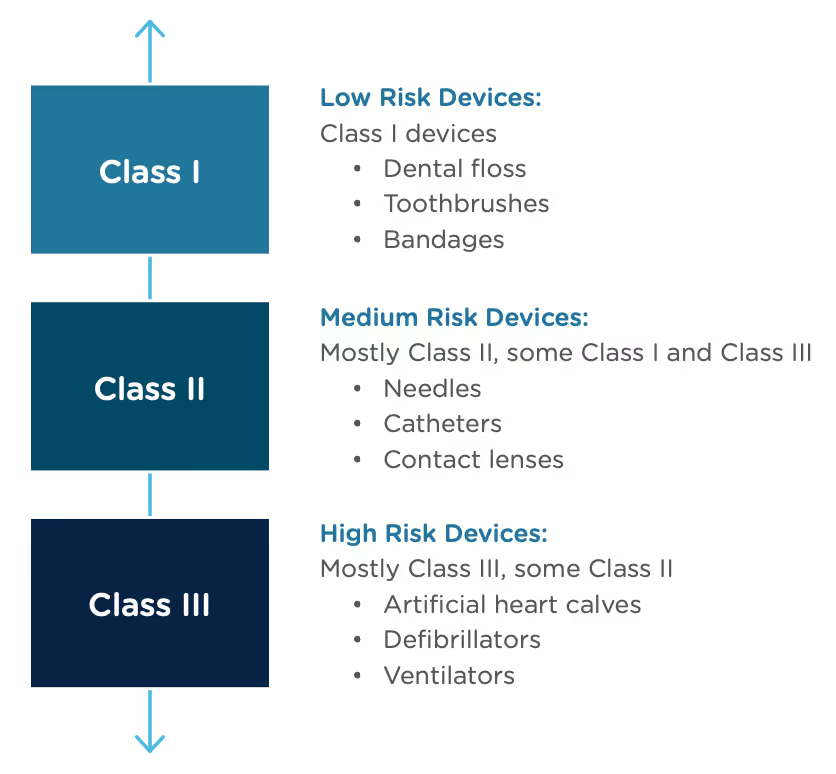
The Food and Drug Administration Modernization Act of 1996 provided the FDA with the authority to create the De Novo Classification Process. It's a process that uses a risk-based strategy for a new, novel kind of medical device, in vitro diagnostic, or medical software solution whose type has previously not been identified and/or classified. It’s a process by which a novel medical device can be classified as a Class I or Class II device, instead of being automatically classified as Class III, which may not be appropriate. Before the implementation of the De Novo process in 1997, all the “not substantially equivalent” (NSE) products were required to be initially classified as a Class III device. But for a lot of devices, this risk class didn’t really make sense. The De Novo process provides a pathway for more accurate classifications of novel, lower-risk devices.
October, 2021, the FDA released a final guidance document "De Novo Classification Process (Evaluation of Automatic Class III Designation)" to provide guidance to the requester (also known as the manufacturer) and the FDA on the process for the submission and review of a De Novo Classification Request under section 513(f)(2) of the Federal Food, Drug, and Cosmetic Act (the FD&C Act). This process provides a pathway to an initial Class I or Class II risk classification for medical devices for which general controls or general and special controls, provide a reasonable assurance of safety and effectiveness, but for which there is no legally marketed predicate device. This guidance document replaced the "New Section 513(f)(2) – Evaluation of Automatic Class III Designation, Guidance for Industry and CDRH Staff" document, dated February 19, 1998.
Consistent with the final rule, the FDA updated the guidance documents below to provide recommendations for submitting De Novo requests, as well as criteria and procedures for accepting, withdrawing, reviewing, and making decisions on De Novo requests, effective January 3, 2022.
- User Fees and Refunds for De Novo Classification Requests
- FDA and Industry Actions on De Novo Classification Requests: Effect on FDA Review clock and Goals
- Acceptance Review for De Novo Classification Requests
The 510(k) and the De Novo processes are similar in that they are both pathways to market for medical devices with low to moderate risk, which is Class I and Class II. The biggest difference between the two is that the 510(k) heavily relies on the concept of "substantial equivalence" to an existing medical device. You must prove this to get the clearance of your 510(k) submission. In the De Novo process, there isn’t a product currently on the market that is “substantially equivalent” to yours, so it’s like starting with a clean slate. For more on the 510(k) process, see our Beginner’s Guide to the 510(k) ebook.
A result of the De Novo process to be aware of is that a successful submission will lead to a new predicate device type that someone else can reference to bring their product to market through the 510(k) process. You’ve done all the work, so now it’s available for anyone to use to provide "substantial equivalence".
De Novo history/timeline
Preparing a De Novo request
1. Do your research! Be sure to complete all the necessary research prior to your submission. You want to be sure that your device is not substantially equivalent to an existing device. Resources to review include:
- The Center for Devices and Radiological Health (CDRH)
- U.S. FDA Device Classification Database
- Device Classification Under Section 513(f)(2)(De Novo)
2. A De Novo request can be submitted with or without a preceding 510(k). There are two options for when you can submit a De Novo request:
Option A: After receiving a not substantially equivalent (NSE) determination (that is, no predicate, new intended use, or different technological characteristics that raise different questions of safety and effectiveness) in response to a 510(k) submission.
Option B: If you’ve determined, after extensive research, that there is no legally marketed device on which to base a determination of substantial equivalence.
3. Be sure all fees are paid to the FDA in advance of submitting a De Novo request. The FDA’s fiscal year begins in October and runs through the following September. Fees have increased each year since they were introduced, but the FDA’s percentage of reviews completed within the 150-day window has increased as well.
A business that is qualified and certified as a “small business” is eligible for a substantial reduction in most of the FDA user fees, including De Novo. The CDRH is responsible for the Small Business Program that determines whether a business is qualified.
Medical Device User Fee Amendments (MDUFA) guidance documents can provide more detailed information about all FDA user fees.
4. The initial request process serves only to determine if the De Novo request is administratively acceptable based upon the Acceptance Checklist. The initial acceptance is followed by substantive review which will determine the final risk classification of your device.
5. A Pre-Submission (Pre-Sub) is a formal written request for feedback from the FDA that is provided in formal written form, and then followed by a meeting. Although a Pre-Sub is not required prior to a De Novo request, it can be extremely helpful to receive early feedback, especially for devices that have not previously been reviewed under a 510(k). If you think you would like to submit a pre-sub first, there are suggested guidelines for submission you should consider:
- Describe your rationale for a Class I or Class II classification for your device.
- Provide the search results of FDA public databases and other resources used to determine that no legally marketed device and no classification for the same device type exists.
- Provide a list of regulations and/or product codes that may be relevant.
- Provide a rationale for why the subject device does not fit within and/or is different from any identified classification regulations, based on available information.
- Identify each health risk associated with the device and the reason for each risk.
- Briefly describe any ongoing and/or planned protocols/studies that need to be completed in order to collect the necessary data to establish the device’s risk profile.
- Provide information regarding the safety and effectiveness of the device. Cite the types of valid scientific evidence you anticipate providing in your De Novo request, including types of data/studies relating to the device’s safety and effectiveness.
- Briefly describe any ongoing and/or planned protocols/studies that need to be completed to collect the necessary safety and effectiveness data.
- Provide protocols for non-clinical and clinical studies (if applicable), including how they will address the risks you anticipate and targeted performance levels that will demonstrate that general controls or general and special controls are sufficient to provide reasonable assurance of safety and effectiveness.
- Share any proposed mitigation measure(s)/control(s) for each risk, based on the best available information at the time of the submission. Highlight which mitigations are general controls and which are special controls and provide details on each.
- Include any other risks that may be applicable, in addition to those identified in the Pre-Sub, given the indications for use for the device.
- If applicable, provide any controls that should be considered to provide a reasonable assurance of safety and effectiveness for the device.
- Provide any non-clinical study protocols that are sufficient to allow the collection of data from which conclusions about device safety and/or effectiveness can be drawn. These protocols should address whether the identified level of concern is the appropriate level of concern for the device software, and if any additional biocompatibility and/or sterility testing is required.
- If clinical data is needed, provide information to show that the proposed study design and selected control groups are appropriate?
6. The FDA will attempt to review the De Novo request submission within 15 calendar days of receipt of the request to make a determination that the submission is declined or accepted for review. If they are unable to complete the review within the 15 days, your submission will automatically move to “accepted for review” status. https://www.fda.gov/regulatory-information/search-fda-guidance-documents/de-novo-classification-process-evaluation-automatic-class-iii-designation
7. There are times when the FDA will refund your application fee. They have created a guidance document “User Fees and Refunds for De Novo Classification Requests” for the purpose of identifying:
- the types of De Novo requests subject to user fees
- exceptions to user fees
- the actions that may result in refunds of user fees that have been paid
When is a De Novo request subject to a user fee?
When will the FDA refund a De Novo user fee?
What fee must be paid for a new device submission following a De Novo “decline” determination?
To continue reading this eBook including a detailed walk-through of all the Traditional 510(k) components, submission requirements and timelines, and an overview of the other 510(k) forms including the Abbreviated 510(k) and the Special 510(k), please register to download the full version.



Is a medical device accessory a medical device?
Rimsys’ own James Gianoutsos recently contributed an article on www.meddeviceonline.com discussing FDA’s guidance document describing accessories and classification pathways.
On Dec. 20, 2017, the FDA issued Medical Device Accessories – Describing Accessories and Classification Pathways: Guidance for Industry and Food and Drug Administration Staff, which applies to the Center for Devices and Radiological Health (CDRH) and Center for Biologics Evaluation and Research (CBER) for combination products.
The guidance document offers welcomed clarity on the role of an “accessory” and its regulatory relationship to its parent device. As always, guidance documents are not legally enforceable; rather, they describe the Agency’s current thinking on a topic and should be viewed only as recommendations, unless specific regulatory or statutory requirements are cited.
The guidance explains which devices FDA generally considers “accessories” and describes the processes under Section 513(f)(6) of the Federal Food, Drug, and Cosmetic Act (FD&C Act) to allow requests for risk- and regulatory control-based classification of accessories. In other words, it specifically details what is and is not an accessory, as well as the regulatory routes to classification.
The updated guidance was derived from an August 2017 amendment to section 513(f) of the FD&C Act (FDA Reauthorization Act of 2017 (Pub. L. 115-52)) to state that “the Secretary shall … classify an accessory under [section 513] based on the risks of the accessory when used as intended and the level of regulatory controls necessary to provide a reasonable assurance of safety and effectiveness of the accessory, notwithstanding the classification of any other device with which such accessory is intended to be used.”
The amendment allows for some accessories to have a lower risk profile than that of their parent device and, therefore, may warrant being regulated in a lower class. As classifications for accessories are now risk-based, it provides manufacturers with regulatory flexibility to loosen some of the regulatory burdens on accessories that may not have the same risk profile as their parent devices.
For example, an accessory to a class III parent device may pose lower risk that could be mitigated through general controls, or a combination of general and special controls, and thus could be regulated as class I or class II. A common example of this would be a ventilation system (parent device) with a face mask (accessory).
Additionally, the guidance details the applicable definitions within Section IV: Definitions:
- Accessory — “A finished device that is intended to support, supplement, and/or augment the performance of one or more parent devices.”
- Component (21 CFR 820.3(c)) — “[A]ny raw material, substance, piece, part, software, firmware, labeling, or assembly which is intended to be included as part of the finished, packaged, and labeled device.”
- Finished Device (21 CFR 820.3(l)) — “[A]ny device or accessory to any device that is suitable for use or capable of functioning, whether or not it is packaged, labeled, or sterilized.”
- Parent Device — “A finished device whose performance is supported, supplemented, and/or augmented by one or more accessories.”
Accessory classification policy
The risks of an accessory are the risks it presents when used with the corresponding parent device as intended. To classify an accessory, FDA addresses the following two questions:
- Is the article an accessory? This can be answered by determining the intended use of the accessory. Is it intended for use with one or more parent devices, and does it support, supplement, and/or augment the performance of one or more parent devices?
- What is the risk of the accessory when used as intended with the parent device(s), and what regulatory controls are necessary to provide a reasonable assurance of its safety and effectiveness? This can be answered by providing a detailed risk assessment, outlining the potential hazards and reasonable regulatory and quality controls necessary to assure the accessory’s safety and effectiveness.
Individual accessories may be classified pursuant to the same regulation as a corresponding parent device, when appropriate, or be regulated independently.
Once an accessory has been classified, there is another consideration manufacturers need to decide: the Unique Device Identifier (UDI) rule. Not only does your parent device need to have a UDI, but any and all accessories each need to be assigned a UDI.
As 21 CFR 801 Labeling, Subpart B, Section 801.20(a) states: “(1) The label of every medical device shall bear a unique device identifier (UDI) that meets the requirements of this subpart and part 830 of this chapter,” and “(2) Every device package shall bear a UDI that meets the requirements of this subpart and part 830 of this chapter.”
Further, 21 CFR 830 UDI, Subpart A, Section 830.3 defines “finished device” and “device package” as follows:
- Finished device* means any device or accessory to any device that is suitable for use or capable of functioning.
- Device package means a package that contains a fixed quantity of a particular version or model of a device.
*Note that, although “medical device” and “finished device” are not consistent terminology used within the chapters, the terms are one and the same.
In short, any sellable finished device must bear a UDI, either on the device itself, on the device package, or both. Components to the finished device (i.e., service components and spare parts kits) are not considered accessories, and therefore are not required to bear a UDI.
What does this ultimately mean for manufacturers?
If there was any confusion as to whether a specific accessory is classified as a medical device, it has now been clarified, or at least partially clarified, depending on your specific situation. If there is still confusion among your engineering and regulatory teams, FDA recommends contacting them, via the accessory classification process outlined in the guidance, to classify the accessory appropriately. FDA will treat each accessory classification request as a Q-Submission. Requests may be for a new accessory type (new classification), an existing accessory type (reclassification), or classification of a new accessory type through the de novo process.
A gap analysis should be performed to identify a thorough and complete list of your current and future accessories to determine applicability to the guidance document. Justification also should be documented, should an accessory not apply to the guidance document. Additionally, internal procedures and the process associated with assigning UDIs may need to be updated to ensure there are no compliance gaps.

Podcast – Streamlining the MDSAP device marketing authorization and facility registration process
I had the opportunity to sit down with Jon Speer, Founder & VP of QA/RA at Greenlight Guru to record a podcast to discuss streamlining the MDSAP Marketing Authorization & Facility Registration Process.
If you are not familiar with this topic, you need to hear this.
We discuss:
- Why your regulatory team may be perceived as a bottleneck and why it is important everyone needs to be on the same page about when the product can be released.
- The connection between marketing authorization and facility registration required for various countries – United States, European Union, or elsewhere.
- The need to get organized, get better systems in place, and stay compliant when an auditor comes through your door or when you plan to sell into markets.
- Why small and large companies need to get organized now (i.e. small companies have too much information to maintain, organize, and track while large companies may have resources but suffer from miscommunication and disjointed processes.)
- The need to not be complacent and not be afraid to change systems. Rimsys was created to help regulatory professionals successfully and efficiently handle documentation.
You can hear the podcast below or at the Greenlight Guru blog.